A FIVEPILLAR MINDSET visual created for this guide. The practical journal exercise appears below.
The Reality of Rebuilding Self-Trust
Self-trust is broken in public declarations and rebuilt through private actions. When you consistently make sweeping resolutions that exceed your current daily capacity, every missed target reinforces a hidden narrative of failure. Rebuilding self-trust requires stripping away emotional hype and focusing on small, unmissable commitments. When you promise yourself to walk for five minutes, log a single meal, or sit in silence before checking your phone, and you actually do it, your brain collects direct proof of your dependability. Systematic reviews on positive expressive writing demonstrate that structured reflection can improve subjective well-being and help clarify personal values over time [S1]. Expressive journaling serves as an active tool for self-governance rather than a substitute for clinical care or professional guidance [S1]. FivePillar Mindset provides a private AI journal with voice input, long-term condensed memory, coach chat, habit tracking, recovery-aware support, monthly reviews, and a printable yearbook to log this daily evidence [F1]. Public articles never populate your private entry feed automatically, ensuring your personal log remains entirely your own work [F2].
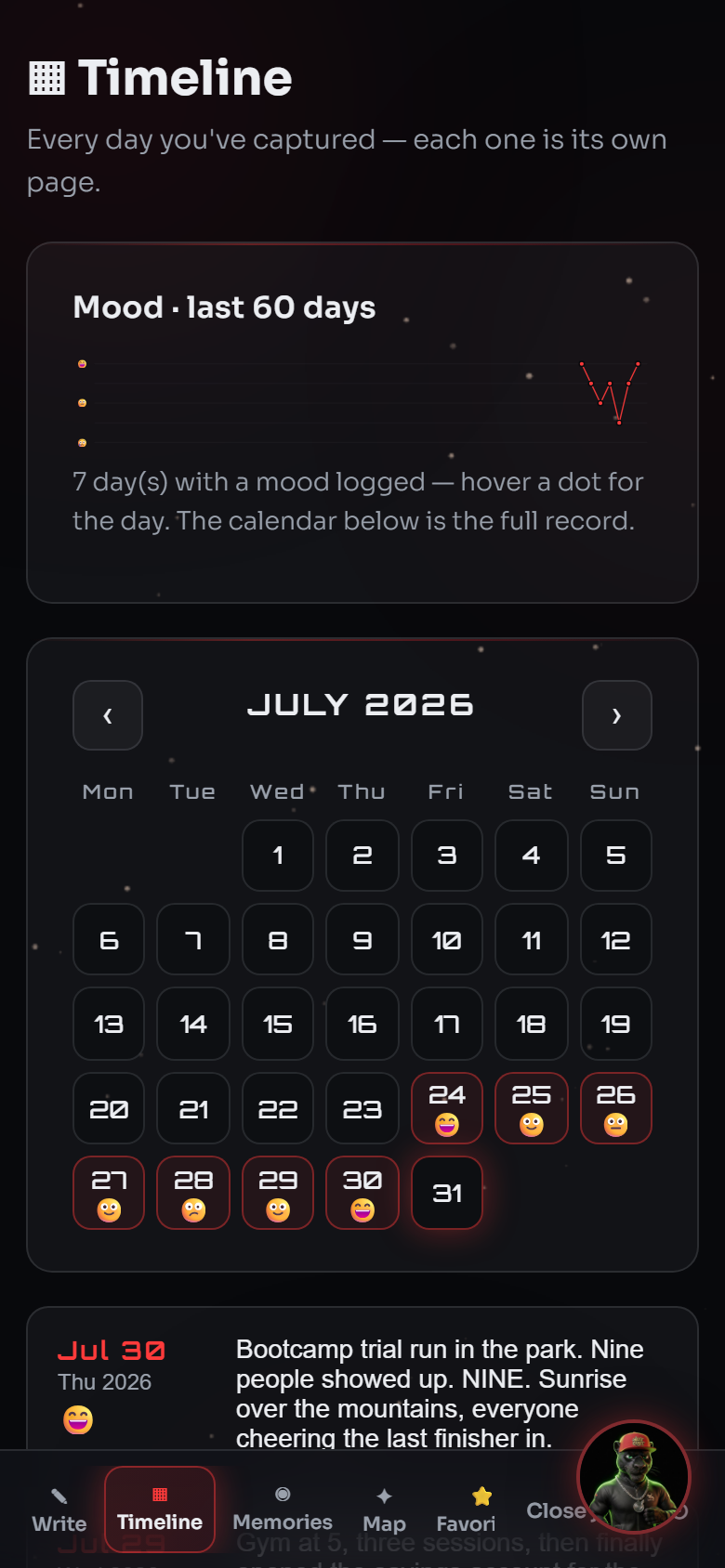
The searchable personal journal timeline in FIVEPILLAR MINDSET. Use the workbook actions in this guide to carry an exercise into your own private entry.
Principles of Micro-Commitment Architecture
To restore self-trust, micro-promises must be structured to eliminate ambiguity and prevent self-deception.
Trivial Scale
Shrink the action until refusal requires more effort than execution.
Immediate Execution
Complete the promise immediately after making it to close the feedback loop.
Uncompromising Tracking
Record what actually happened without distorting or softening the outcome.
Clear Context
Anchor your commitment to specific times, places, or established daily triggers.
Try this in your journal
Use your private workspace to execute a daily self-trust audit using small promises and clear reflection. Make a note about this in your journal: 'What is one promise under two minutes I will execute today without fail?' Ask your coach: 'How can I break my current evening goal into three smaller, unmissable commitments?'
Speak Your Promise
Use voice input to state one micro-commitment for the next two hours, keeping it precise and realistic [F1].
Log the Verification
Once completed, record a quick entry, habit checkoff, photo, or location tag as unshakeable proof [F1].
Catalog Contextual Details
Save associated favorites like places, books, or activities in your searchable library tool [F5].
Review Memory Synthesis
Observe how your coach incorporates verified facts into its bounded rolling summary capped at 600 words without storing raw prose clutter [F3].
Self-trust is not an emotion you feel before taking action; it is the quiet confidence that remains after you keep a small promise to yourself when nobody is watching.
Grounded Mindset
Repairing Slips Without Narrative Collapse
Missed promises are inevitable during personal recovery and habit formation, but a slip only destroys self-trust if you distort the truth or abandon the protocol. When you fail to keep a small commitment, the goal is immediate repair rather than dramatic self-punishment. Acknowledge the slip clearly, document the environmental or emotional friction that caused it, and set a smaller promise immediately. FivePillar Mindset offers recovery-aware support that helps you evaluate lapses with objective neutrality rather than shame [F1]. Crucially, generated drafts, blog copy, scripts, research text, and coach prose are explicitly excluded from your personal memory condensation [F4]. This ensures your long-term memory record reflects only your true personal history and authentic statements, keeping your self-trust data clean and trustworthy [F4].
Quantifiable Evidence of Personal Consistency
By converting abstract self-growth into tangible structure, you replace vague feelings with clear documentation.
600-Word Memory Cap
Bounded rolling summary length reserved strictly for verified personal facts [F3].
Structured monthly reviews summarizing habits and growth into a printable yearbook [F1].
Begin Building Your Private Record Today
Stop relying on fleeting motivation and start accumulating verifiable proof of your reliability. FivePillar Mindset gives you the tools, voice input, habit tracking, and memory architecture needed to build unshakeable self-trust one small promise at a time [F1].
Small promises minimize cognitive resistance, making execution manageable. Keeping them regularly provides concrete empirical proof that you follow through on your intentions, shifting your self-identity from unreliable to consistent over time [S1].
Does journaling replace therapy or recovery treatment?
No. While positive expressive writing supports subjective well-being and personal goal organization [S1], it is an educational self-reflection tool, not a substitute for clinical healthcare or licensed medical therapy.
How does the FivePillar AI coach handle my personal journal entries?
The coach maintains a bounded rolling summary capped at 600 words for lasting personal facts [F3]. Full private entries remain separate, and generated copy, drafts, or scripts are explicitly excluded from memory condensation [F4].
Are my public reading habits or saved articles added to my private memory?
No. You select what you write or save; public articles are never automatically copied into your private journal entries or long-term memory summary [F2].
FROM EDUCATION TO PERSONAL ACTION
Use this insight inside FIVEPILLAR MINDSET
This article remains public educational content. Inside the private journal, you decide whether to apply it to your own life, save a reflection or discuss it with your coach.
Connected people and memoriesConnect reflections to the people and moments involved without automatically sharing private journal content.See how this feature works →
One Life Coach Operating SystemThe journal, memory, goals, timeline, map, favorites, coach and books are connected views—not separate journals.Explore the complete system →
Try it without an accountUse fictional sample data to feel the raw-words-to-coaching transformation. Nothing is saved and no paid AI call is made.Open the interactive demo →
Sources & verified facts
Product: A private AI journal with voice input, long-term condensed memory, coach chat, photos, places, habits, recovery-aware support, monthly reviews and a printable yearbook.
Private app behavior: Members choose what they write or save; public articles are not automatically copied into private journal entries.
Coach memory: The coach uses a bounded rolling summary capped at 600 words for lasting personal facts, while full private entries remain separate.
Memory exclusions: Generated drafts, blog copy, scripts, research text and the coach's prose are explicitly excluded from personal memory condensation.
Library tools: The journal supports searchable favorites for people, songs, dishes, recipes, places, books, activities, products and memories.
This article is for educational and self-development purposes only and does not constitute medical, clinical, or psychological advice. Journaling and coaching features support personal discipline and reflection but do not replace professional healthcare or mental health treatment.