A Grounded One Day at a Time Recovery Journal Routine
Build daily discipline, manage difficult moments, and document your personal growth with a structured, three-part journaling practice designed for recovery and long-term reflection.
A FIVEPILLAR MINDSET visual created for this guide. The practical journal exercise appears below.
🧭 The Recovery Path · Stage 2 of 6 — One day at a time · See the whole path
The Daily Anchor of Recovery
In the journey of recovery and personal growth, the phrase 'one day at a time' is more than a slogan—it is a practical strategy for managing cognitive overwhelm and emotional turbulence [S3]. When you focus entirely on the 24 hours in front of you, the path ahead becomes manageable. Journaling acts as a daily anchor, a private mirror where you can process your thoughts, track your behavioral habits, and realign your actions with your core values [F1]. Grounded in the foundational recovery principles shared by community support networks like Alcoholics Anonymous [S1] and Narcotics Anonymous [S2], a dedicated writing routine helps you maintain complete self-honesty, practice consistent gratitude, and maintain regular contact with your support system [S3].
Writing down your daily experiences provides an objective record of your progress. Instead of relying on selective memory, a recovery journal documents your real-time emotional state, your challenges, and your triumphs [F1]. By committing to a consistent morning, midday, and evening routine, you build a steady habit of self-reflection that fosters long-term mental clarity and emotional sobriety [S3].
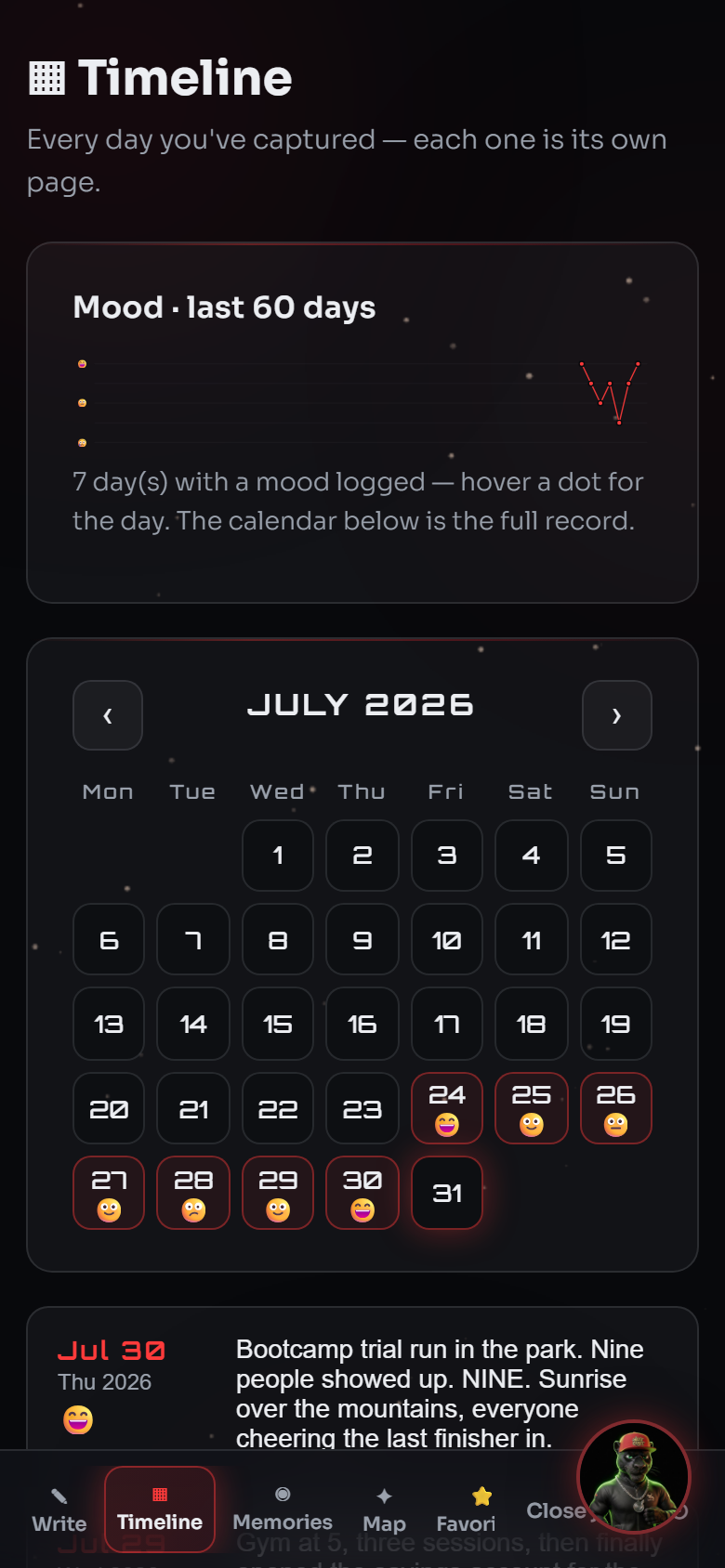
The searchable personal journal timeline in FIVEPILLAR MINDSET. Use the workbook actions in this guide to carry an exercise into your own private entry.
The Three-Part Daily Routine
To build a resilient mindset, break your journaling practice into three highly specific daily check-ins. This keeps your reflection manageable and prevents you from feeling overwhelmed by the weight of long-term expectations.
1. Morning Focus: Alignment and Intention
Begin your day by grounding your mind. Spend five minutes writing down your immediate thoughts, three things you are genuinely grateful for, and your primary focus for the day. Explicitly state one action you will take to maintain your recovery and support others [S3]. Make a note about this in your journal: 'Write down the name of one peer, sponsor, or trusted friend you plan to reach out to today to maintain active connection [S1, S2].'
2. Midday Pause: Navigating Difficult Moments
When stress, anger, or cravings arise, use your journal as a pressure-release valve. Stop and write down exactly what you are feeling without judgment. Use this moment to identify any triggers, acknowledge your physical state (Hungry, Angry, Lonely, Tired), and commit to the 'next right action' instead of reacting impulsively.
3. Evening Reflection: Honest Self-Assessment
Close your day with an objective review. Assess your actions, note where you were helpful or where you fell short, and celebrate the small victories of the day [S3]. Document the places you visited, the habits you maintained, and any lessons learned to build a permanent, honest record of your growth [F1, F5].
Aligning with Recovery Principles
This journaling structure naturally mirrors the core principles of established 12-step programs without reproducing their literature or claiming any formal affiliation [S1, S2]. For instance, the practice of an evening review aligns closely with taking a regular personal inventory, allowing you to quickly spot resentments, fears, or dishonest patterns before they grow [S1]. Meanwhile, noting down your support outreach ensures you stay connected with sponsors, peers, and recovery communities [S1, S2].
However, it is critical to recognize the healthy boundaries of private reflection. While a recovery journal is a vital tool for personal discipline, self-honesty, and tracking habits [F1], it is not a cure-all. Recovery is built on community, mutual support, and professional clinical resources when necessary [S3]. Your journal should complement, not replace, your active participation in meetings [S1, S2], your communication with a sponsor or counselor, and your engagement with clinical recovery systems [S3].
Try this in your journal
Use these structured steps within your FivePillar Mindset private journal to build a seamless, recovery-aware daily routine [F1].
Step 1: Use Voice Input for Raw Emotion
When you are in a difficult moment or short on time, don't worry about perfect spelling or grammar. Tap the voice input button to speak your raw, unfiltered feelings directly into your private journal [F1]. This helps clear your mind and provides an immediate emotional release.
Step 2: Catalog Your Safe Zones and Support Network
Use the searchable favorites library tool to log positive places, recovery meetings [S1, S2], inspiring books, and supportive people [F5]. When you are struggling, you can quickly search your favorites to remind yourself of safe spaces and immediate contacts [F5].
Step 3: Review Your Insights with Coach Chat
Engage with the private coach chat to analyze your entries and process your thoughts [F1]. The coach uses a bounded rolling summary limited to 600 words for lasting personal facts, keeping your individual journal entries completely private while providing context-aware guidance [F3].
Step 4: Track Daily Habits and Recovery Milestones
Log your daily habits, places visited, and recovery-aware activities [F1]. Over time, these entries accumulate into your monthly reviews and can be printed into a physical yearbook, serving as a permanent, tactile record of your commitment to change [F1].
Built for Absolute Privacy and Personal Growth
The FivePillar Mindset digital journal is built specifically to protect your inner thoughts while helping you build lasting discipline [F1]. Your entries remain entirely yours, structured around rigorous privacy guidelines.
Completely Private App Behavior
You retain full ownership over your words. Members choose exactly what they write or save, and public marketing or educational articles are never automatically copied into your private journal entries [F2].
Bounded rolling coach summary
To protect your privacy while offering helpful feedback, the coach chat uses a rolling memory capped at 600 words to remember key, high-level personal facts, while your full private journal entries remain separate and protected [F3].
Strict Data Exclusions
To keep your memory stream clean and relevant, the system explicitly excludes generated drafts, blog copy, scripts, research text, and the coach's own prose from your personal condensed memory [F4].
Understanding the Limitations of Journaling
While daily writing is an exceptional tool for reinforcing personal accountability and tracking your emotional states, it is important to maintain realistic expectations. Journaling is a self-reflective exercise, not a clinical treatment, therapy session, or medical intervention. It does not cure substance use disorders, alleviate mental health crises, or replace the necessary medical support recommended by healthcare professionals [S3].
If you are struggling with severe addiction, mental health challenges, or a potential relapse, please reach out to professional medical services, crisis hotlines, or established recovery support groups like Alcoholics Anonymous [S1], Narcotics Anonymous [S2], or the Substance Abuse and Mental Health Services Administration (SAMHSA) [S3]. Use your journal as a companion to these critical resources, helping you document your thoughts as you actively work with professionals and peers in your physical community [S1, S2, S3].
Ask your coach: 'Based on my recent evening entries, what patterns of gratitude or physical fatigue have I consistently logged over the past two weeks?' [F1, F3]
"Discipline isn't about feeling like doing the work; it's about showing up and doing the work when you don't feel like it. One day, one step, one journal entry at a time."
A Motivating Word on Daily Discipline
Begin Your One Day at a Time Journal Routine
Take control of your daily reflection with a private, recovery-aware digital journal designed for long-term accountability [F1]. Use voice input, track your daily habits, consult with an intelligent coach, and build a permanent, physical record of your personal growth with our printable yearbook [F1]. Start your journey today.
How does a recovery journal help with the 'one day at a time' approach?
It breaks your reflection into immediate morning, midday, and evening entries, allowing you to focus entirely on managing your current 24 hours. This structure prevents cognitive overwhelm and helps you build daily discipline [S3].
Is my journal data kept private?
Yes. Members choose exactly what they write or save [F2]. Furthermore, our coach chat uses a rolling personal memory capped at 600 words for context, while your full private journal entries remain completely separate [F3].
Can journaling replace active recovery meetings or therapy?
No. Journaling is a supportive tool for self-reflection and tracking habits [F1]. It does not replace professional therapy, clinical treatment, or active participation in peer support groups like AA or NA [S1, S2, S3].
What elements are excluded from the AI coach's memory?
To protect your privacy and maintain a clean context, the coach's memory explicitly excludes generated drafts, blog copy, scripts, research text, and the coach's own prose [F4].
FROM EDUCATION TO PERSONAL ACTION
Use this insight inside FIVEPILLAR MINDSET
This article remains public educational content. Inside the private journal, you decide whether to apply it to your own life, save a reflection or discuss it with your coach.
Recovery-aware journalUse private daily inventory, milestone reflection and optional program-aware support alongside real-world care.See how this feature works →
One Life Coach Operating SystemThe journal, memory, goals, timeline, map, favorites, coach and books are connected views—not separate journals.Explore the complete system →
Try it without an accountUse fictional sample data to feel the raw-words-to-coaching transformation. Nothing is saved and no paid AI call is made.Open the interactive demo →
Sources & verified facts
Product: A private AI journal with voice input, long-term condensed memory, coach chat, photos, places, habits, recovery-aware support, monthly reviews and a printable yearbook.
Private app behavior: Members choose what they write or save; public articles are not automatically copied into private journal entries.
Coach memory: The coach uses a bounded rolling summary capped at 600 words for lasting personal facts, while full private entries remain separate.
Memory exclusions: Generated drafts, blog copy, scripts, research text and the coach's prose are explicitly excluded from personal memory condensation.
Library tools: The journal supports searchable favorites for people, songs, dishes, recipes, places, books, activities, products and memories.
FivePillar Mindset offers a private journal and wellness education platform [F1]. It does not provide medical advice, diagnosis, treatment, or clinical therapy. Our recovery-aware support tools are designed to assist with personal organization, habit tracking, and self-reflection, and should not be used as a replacement for professional medical care, addiction treatment programs, or crisis intervention services [S3].