Reduce Friction
Remove decision fatigue by preparing tools, clearing physical workspaces, and narrowing immediate choices down to a single clear next step.
Motivation is a feeling that fluctuates. True progress requires lowering friction, executing minimum viable actions, and relying on systems rather than temporary emotion.

Motivation is inherently transient, shifting with sleep, stress, and external factors. When drive inevitably drops, waiting for feeling to precede action leads to stagnation. The core principle of disciplined personal growth rests on moving first and letting emotion follow. Instead of forcing high-energy enthusiasm, successful execution requires dismantling resistance through reduced friction and defined minimum steps. Shaun 'Gotti' Williams' five-pillar philosophy emphasizes that daily consistency is forged in the moments when emotion is completely absent. When you replace emotional reliance with repeatable systems, you eliminate the mental debate that drains executive function. Acknowledge the absence of motivation as a natural biological state rather than a personal failing, then execute a micro-commitment immediately to re-establish agency and momentum.
Navigating low-motivation periods requires a practical playbook rather than vague encouragement. By systematically addressing friction, scope, physical environment, personal value alignment, and social accountability, you preserve continuous forward motion regardless of mood.
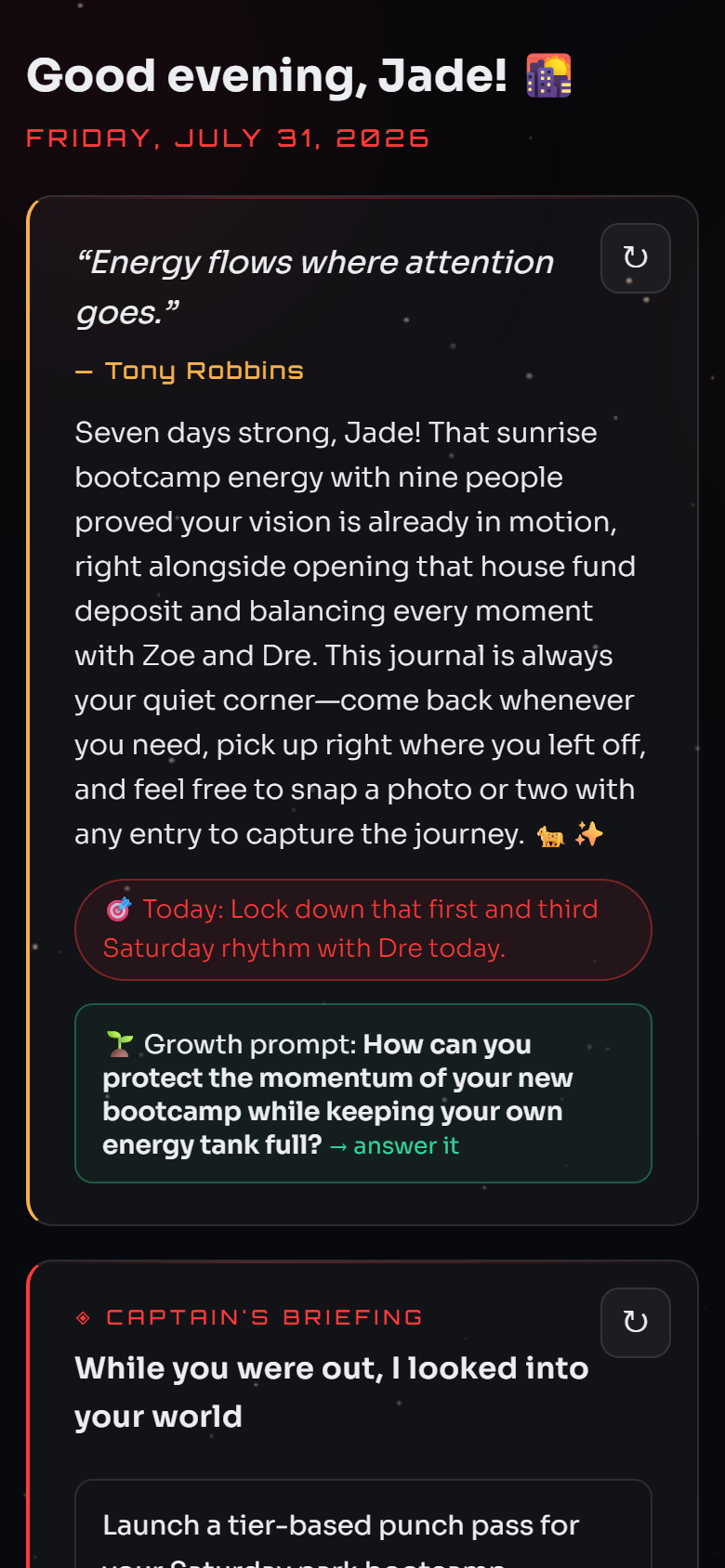
Integrating reflection into your daily system creates a permanent record of resilience and helps track what strategies restore your momentum [F1]. Members choose what they write or save, ensuring private reflections remain completely under personal control while building long-term memory summaries [F2][F3]. Make a note about this in your journal whenever motivation drops, and use the prompt below to engage your AI coach [F1].
When psychological inertia is high, the heaviest lift is initiating the first motion. Lowering friction means eliminating every unnecessary obstacle between you and the starting line. If your objective is a full hour workout, scale it down to putting on your shoes and completing two minutes of movement. This minimum viable action breaks freeze responses without triggering overwhelming internal resistance. Once the threshold is crossed, momentum frequently carries you beyond the initial micro-goal. Even if you stop precisely at two minutes, you preserve habit consistency and reinforce identity as someone who executes daily. Over months and years, preserving continuous operational habits during severe dips yields exponentially greater compounding growth than sporadic bursts of high-intensity effort driven purely by emotional spikes.
Your immediate environment dictates behavioral tendencies far more than willpower ever can. Restructuring your room or desk—removing phone notifications, setting out equipment the night before, and isolating key focus areas—creates a physical path of least resistance toward execution. Simultaneously, reconnecting to core meaning provides necessary perspective during grind phases. Remind yourself why the work matters to your long-term personal growth, health, or family obligations. Capturing these personal reflections and favorited references in a structured space builds an enduring reference point you can review when internal clarity fades [F5].
While practical discipline and friction reduction resolve routine slump phases, prolonged loss of motivation accompanied by severe emotional distress or fatigue may signal deeper challenges. It is vital to distinguish between normal motivational friction and mental health conditions or burnout. Relying solely on self-help protocols during acute mental health struggles, substance issues, or severe depression is insufficient. When low motivation stems from broader health crises, seeking external human support and professional medical guidance is essential [S1]. Programs and organizations like SAMHSA provide evidence-based resources and specialized care options to support holistic well-being [S1]. Integrating health awareness with daily self-management tools ensures that personal growth practices support long-term stability without replacing vital clinical or professional care [S1].
Consistency is not built on temporary motivation, but on permanent systems that hold you accountable every single day. FivePillar Mindset gives you a private AI journal with voice input, recovery-aware habit tracking, coach chat, monthly reviews, and a printable yearbook to record your life's journey [F1]. Start capturing your daily actions, tracking habit milestones, and building an unshakeable system for long-term personal evolution today [F1].
Explore FivePillar MindsetWhen motivation disappears, lower task friction and execute a minimum viable action—such as working for two minutes or completing a single micro-step. Focus on immediate physical movement rather than waiting for emotional inspiration.
Lower friction by preparing your workspace in advance, removing digital distractions, breaking larger objectives into small micro-steps, and eliminating decision points before you begin.
FivePillar Mindset provides private voice journaling, recovery-aware habit tracking, and coach guidance to capture reflections and track daily actions without overwhelming manual effort [F1].
Normal lack of motivation is temporary inertia manageable through habit systems. Severe burnout or prolonged emotional distress may require professional medical or mental health support from services like SAMHSA [S1].
FROM EDUCATION TO PERSONAL ACTION
This article remains public educational content. Inside the private journal, you decide whether to apply it to your own life, save a reflection or discuss it with your coach.