A setback is a temporary event in your timeline; giving up is the choice to stop taking ownership. Learn how to interpret stumbles with clarity and direct action.
A FIVEPILLAR MINDSET visual created for this guide. The practical journal exercise appears below.
Reframing Stumbles: Event Versus Identity
When a goal or habit breaks, the mind often rushes to construct a narrative of permanent failure. Understanding the difference between a setback and giving up starts with separating who you are from what just occurred. A setback is a discrete event bounded by time, circumstance, and specific decisions. Giving up, by contrast, is the internal choice to abandon responsibility and stop engaging in intentional repair. Navigating behavioral health challenges, habit breaks, or personal recovery requires recognizing that momentary slips do not erase prior progress or determine future capacity [S1]. When an unexpected interruption occurs, treating it as an absolute failure creates emotional paralysis. Grounded discipline demands that you acknowledge real consequences without weaponizing them against your character. By focusing on objective facts rather than catastrophic assumptions, you preserve the psychological clarity required to inspect what went wrong and identify actionable adjustments. Recovery support resources emphasize that developing healthy coping strategies and maintaining self-directed ownership are fundamental to overcoming obstacles across personal growth and daily routines [S2].
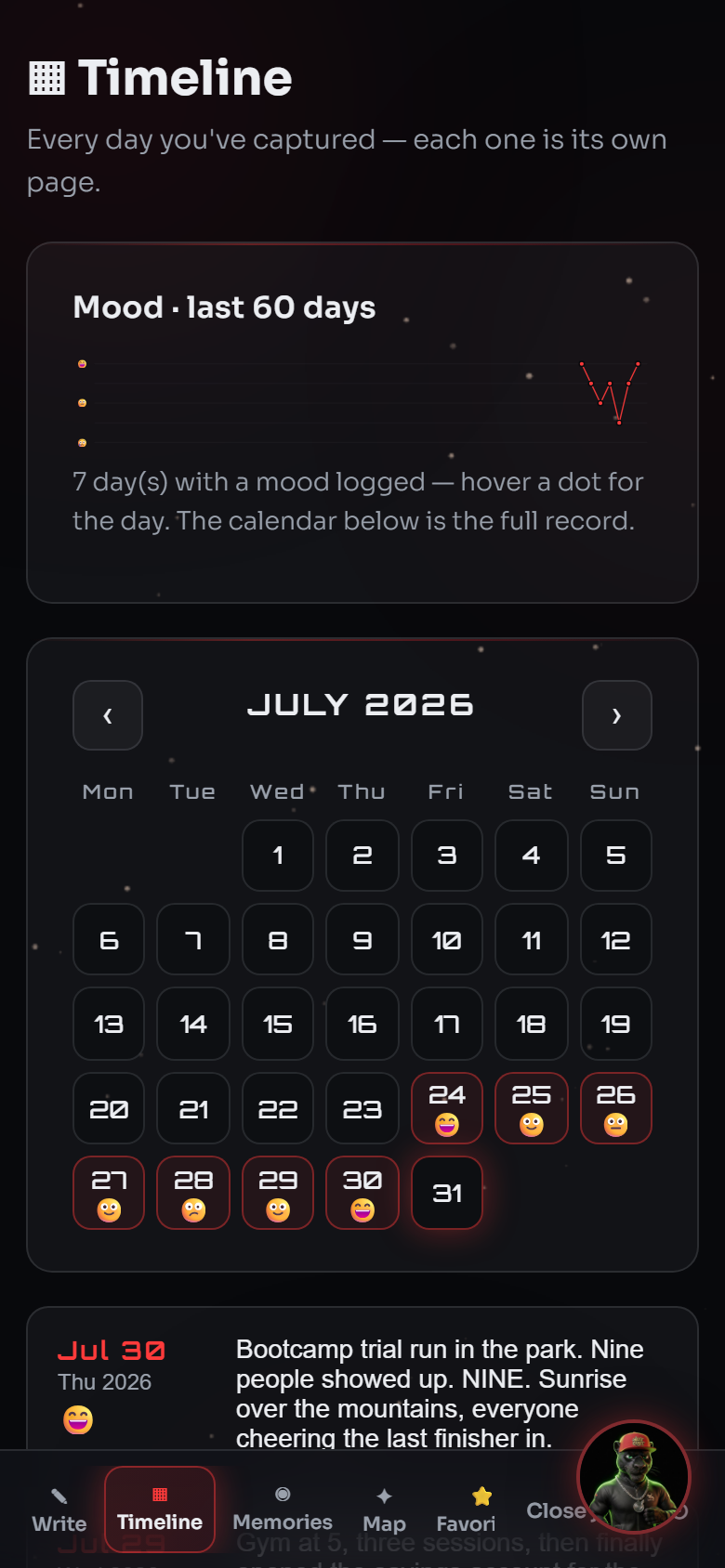
The searchable personal journal timeline in FIVEPILLAR MINDSET. Use the workbook actions in this guide to carry an exercise into your own private entry.
Distinguishing a Setback from Giving Up
Distinguishing between temporary slips and active surrender requires inspecting your internal dialogue, emotional state, and immediate actions.
Temporal Scope: Isolated Event vs. Total Abandonment
A setback is a localized event that occurred at a specific time and context. Giving up expands that single moment into a permanent state, assuming that because a slip happened today, future effort is meaningless [S1].
Internal Narrative: Objective Review vs. Character Verdict
Experiencing a setback leads to asking what conditions triggered the break. Giving up translates the friction into an identity claim, convincing yourself that you lack discipline or integrity entirely.
Behavioral Trajectory: Active Repair vs. Passivity
A setback prompts active review, honest repair, and adjusting systems to prevent recurrence. Giving up results in passive withdrawal and avoiding accountability [S2].
Perspective on Progress: Accumulated Value vs. Zero Balance
A setback honors the foundation, habits, and clean days built prior to the stumble. Giving up falsely claims that a single mistake resets all past progress to zero.
The Four-Step Framework: Review, Support, Repair, Next Action
When an obstacle occurs, follow a structured protocol to prevent emotional spirals and restore momentum through concrete steps.
Step 1: Conduct an Unvarnished Review
Strip away emotional commentary and record the exact facts: what time it happened, what triggers were present, and where the plan broke down.
Step 2: Engage Recovery-Aware Support
Reach out to support systems, trusted mentors, or structured wellness tools to ground your perspective and counter isolation [S1], [S2].
Step 3: Execute Immediate Practical Repair
Address the direct consequences of the event immediately. If an apology is owed, make it; if a boundary was crossed, re-establish it clearly.
Step 4: Commit to the Next Useful Action
Select a single, immediate habit or micro-task within your control today rather than trying to fix your entire life all at once.
Navigating Recovery-Aware Support and Habit Resilience
Building long-term discipline is rarely a smooth, linear trajectory. Whether you are building daily routines, working through recovery, or aiming for professional milestones, setbacks are inevitable friction points along the journey. According to federal recovery support frameworks, individual choice, personal responsibility, and peer support form essential pillars for sustained personal growth [S1]. Coping effectively involves establishing structured routines, recognizing personal triggers early, and utilizing grounded wellness strategies [S2]. Rather than relying on temporary motivation, resilient individuals rely on concrete systems that absorb shocks without collapsing. FivePillar Mindset provides a private AI journal with voice input, long-term condensed memory, coach chat, photos, places, habits, recovery-aware support, monthly reviews and a printable yearbook to record your full journey [F1]. Members choose what they write or save, ensuring that public articles or educational materials are never automatically copied into private journal entries [F2]. Having a reliable, private space to evaluate progress allows you to process hard truths calmly.
Try this in your journal
Use these targeted exercises within your private journal to process a recent challenge and establish direct accountability.
1. Voice-Log the Facts Without Judgment
Use hands-free voice input in your journal [F1] to describe the exact events of the setback, focusing purely on observable facts rather than personal insults.
2. Tag Your Searchable Favorites and Places
Categorize the entry using searchable favorites for places, activities, or triggers involved [F5] to help spot environmental patterns over time.
3. Make a note about this in your journal
Write down one specific repair step you will execute today to clean up the impact of the event and protect your boundaries.
4. Ask your coach for an objective review
Open coach chat [F1] and ask: 'Based on my recent entries, what simple adjustment can I make to prevent this specific friction point tomorrow?' Note that coach memory uses a bounded rolling summary capped at 600 words for personal facts [F3], while generated drafts, blog copy, and research text are explicitly excluded from memory condensation [F4].
A setback only becomes permanent when you stop showing up to do the work. Discipline is built in the turn-around.
A Principle for Daily Discipline
Build a Permanent Record of Your Growth
Stop letting single stumbles define your direction. Document your daily habits, track real progress, and build resilient momentum with FivePillar Mindset.
How do I tell if a setback is a sign I should change my strategy?
An isolated setback usually requires minor tactical adjustments rather than abandoning your entire goal. Look at whether the breakdown occurred due to poor preparation, temporary fatigue, or an unrealistic expectation. If repeated review shows consistent systemic failure despite honest execution, adjusting your strategy is reasonable, but giving up on your underlying values is not.
What should I do immediately after breaking a habit or routine?
Pause before reacting. Record the factual details of what happened in your journal without self-flagellation [F1]. Identify the immediate repair needed, fulfill it, and immediately execute your next scheduled healthy habit [S2]. Do not attempt to over-compensate with extreme penalties.
Is journaling alone enough to overcome serious recovery challenges?
No. Journaling is a powerful self-reflection and habit-tracking tool, but it does not replace professional care, medical supervision, or dedicated recovery support networks [S1], [S2]. It serves as a personal baseline to help you stay accountable alongside community support.
How does the AI coach keep track of my history without storing unneeded text?
The coach utilizes a bounded rolling memory capped at 600 words for core personal facts [F3]. External materials, drafts, and research texts are explicitly excluded from memory condensation [F4], keeping your personal summary clean and focused.
FROM EDUCATION TO PERSONAL ACTION
Use this insight inside FIVEPILLAR MINDSET
This article remains public educational content. Inside the private journal, you decide whether to apply it to your own life, save a reflection or discuss it with your coach.
AI journal and contextual coachCapture the reflection in your own words and ask a coach that can use bounded, editable personal context.See how this feature works →
One Life Coach Operating SystemThe journal, memory, goals, timeline, map, favorites, coach and books are connected views—not separate journals.Explore the complete system →
Try it without an accountUse fictional sample data to feel the raw-words-to-coaching transformation. Nothing is saved and no paid AI call is made.Open the interactive demo →
Sources & verified facts
Product: A private AI journal with voice input, long-term condensed memory, coach chat, photos, places, habits, recovery-aware support, monthly reviews and a printable yearbook.
Private app behavior: Members choose what they write or save; public articles are not automatically copied into private journal entries.
Coach memory: The coach uses a bounded rolling summary capped at 600 words for lasting personal facts, while full private entries remain separate.
Memory exclusions: Generated drafts, blog copy, scripts, research text and the coach's prose are explicitly excluded from personal memory condensation.
Library tools: The journal supports searchable favorites for people, songs, dishes, recipes, places, books, activities, products and memories.
This article is for educational purposes only and does not constitute medical, psychological, or clinical advice. If you are experiencing a mental health or substance use crisis, please seek professional assistance or reach out to SAMHSA support resources.