A FIVEPILLAR MINDSET visual created for this guide. The practical journal exercise appears below.
🧭 The Recovery Path · Stage 2 of 6 — One day at a time · See the whole path
The Trap of Performative Spirituality
When many people hear the words 'spiritual inventory,' they immediately picture a highly structured, rigid process designed to prove how good, moral, or pious they are. This is the performance trap. In this trap, journaling becomes an exercise in impression management—writing down the things we think we *should* feel rather than the messy reality of what we are actually experiencing. We edit our anger, sanitize our resentments, and perform for an imaginary audience. This performance kills the very humility and honesty required for real personal growth.
A spiritual inventory journal without performance is different. It is not about keeping a spiritual scorecard or impressing a higher power, a mentor, or yourself. It is a practical, grounded discipline of looking at your life exactly as it is today. Whether you come from a deep faith tradition, are in active recovery, or are still figuring out what you believe, the goal remains the same: radical self-honesty. By writing down your true actions, values, and thoughts without the need to look perfect, you begin to dissolve the gap between who you pretend to be and who you actually are. This honest practice is a primary vehicle for lasting change, helping you track your patterns over time without the exhausting burden of moral posturing.
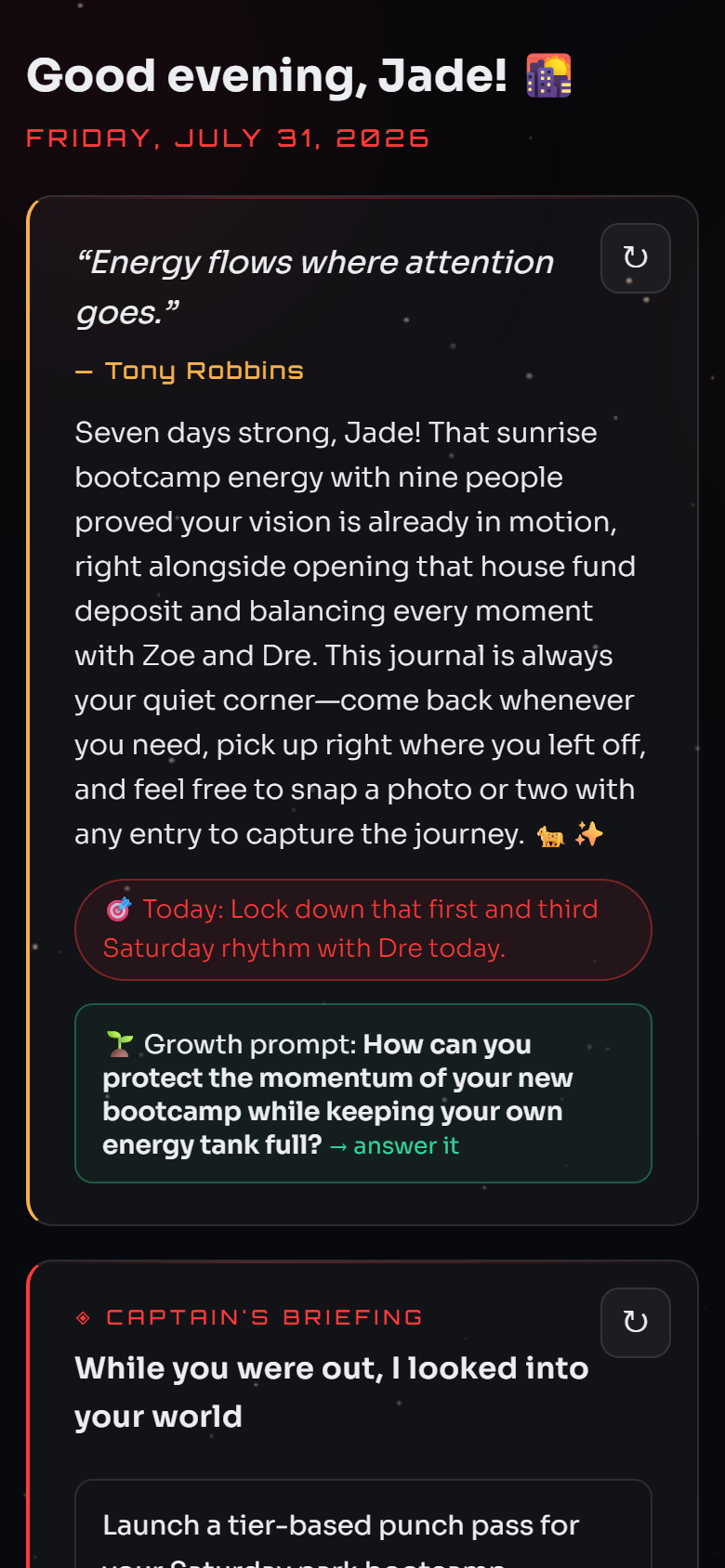
The private daily writing workspace in FIVEPILLAR MINDSET. Use the workbook actions in this guide to carry an exercise into your own private entry.
Values, Humility, and the Mechanics of Resentment
To build an inventory that actually works, you must focus on concrete areas: your values, your resentments, your fears, and your relationships. Resentment is often the starting point. When we carry unexamined grudges, they dictate our choices, disrupt our discipline, and corrupt our daily habits. A performance-free inventory does not ask you to instantly 'forgive and forget' to prove your spiritual maturity. Instead, it asks you to list the resentment plainly: Who are you angry at? What did they do? How does it affect your security, self-esteem, or ambitions?
This process requires deep humility. Humility is not about beating yourself up or pretending to be small; it is simply seeing yourself at your true size. When you write about resentment, humility allows you to look for your own part in the conflict. Did you set unrealistic expectations? Did you act out of fear or pride? By identifying your own patterns, you shift from a victim mindset into a state of active ownership. This transition from blame to self-examination is where healing begins. Gratitude and service then cease to be performative badges; they become quiet, daily actions that align with your core values rather than public spectacles.
Try This in Your Journal
Use these practical steps to build an unvarnished spiritual inventory using the specific tools designed for private, recovery-aware reflection.
1. Speak Your Unedited Truth
Start your session by using voice input to speak freely without pausing to self-edit [F1]. Do not worry about grammar, spiritual language, or sounding polite. Let your raw feelings about a specific resentment or struggle come out naturally.
2. Map the Physical Context
Document the places where your spiritual blocks or moments of clarity occur [F1]. Note down specific locations, environments, or even songs that trigger resentment or bring you peace, saving them to your searchable favorites for future reference [F5].
3. Identify Your Part with Coach Chat
Engage with the private coach chat to help break down the situation [F1]. The coach uses a bounded, rolling summary capped at 600 words to remember your ongoing personal context [F3] while keeping your full private entries completely separate and secure.
4. Set a Concrete Action and Habit Tracker
Translate your reflection into a tangible habit [F1]. If you identified a pattern of fear, set a daily habit to practice quiet reflection or a small act of unacknowledged service, tracking your execution over time.
A Sanctuary for Your Unfiltered Thoughts
Your spiritual inventory is useless if you cannot trust that it is completely private. If you fear someone else will read your rawest thoughts, you will inevitably slip back into writing a performance. The FivePillar Mindset private AI journal is engineered explicitly to protect your raw data and support your growth journey [F1].
Total Privacy Control
Members choose exactly what they write or save. Public articles and educational resources are never automatically copied or pushed into your private journal entries, keeping your personal workspace clean and focused [F2].
Protected Contextual Memory
To keep your reflections safe, generated drafts, blog copy, scripts, and the coach's prose are strictly excluded from your personal condensed memory [F4]. Your personal memory updates only when you decide.
Searchable Favorites Library
Keep a permanent record of the things that ground you. Easily organize and search through your favorite books, recovery tools, songs, places, and meaningful personal memories as you navigate your spiritual development [F5].
Long-Term Condensed Memory
The journal's recovery-aware design helps you track your growth over months and years [F1]. Instead of losing your insights to the archive, the long-term condensed memory helps you see the progress you are actually making over time.
Spiritual progress isn't about looking holy on a Sunday or writing poetic prose to make yourself feel advanced. It's about looking in the mirror on a Tuesday morning, admitting you were wrong, and changing how you treat the people around you. That's the only inventory that matters.
Grounded Discipline
The Scientific Nuance of Self-Reflection
Understanding the limits and evidence of journaling is critical to maintaining a grounded, non-hyped approach to your mental and spiritual wellness.
Evidence-Based Support
A systematic review and meta-analysis of journaling shows its utility in helping manage symptoms of mental illness and chronic stress [S1]. However, its clinical efficacy as a standalone treatment varies, and it is most effective when used as a supplementary tool.
No Medical Guarantees
A spiritual inventory journal is a powerful tool for self-discipline, habit-building, and personal reflection [F1]. It does not claim to cure, treat, or prevent any mental health conditions or clinical disorders [S1].
Professional Boundaries
An AI coach is designed to offer supportive, recovery-aware reflection and structure [F1]. It is not a therapist, a sponsor, or a medical professional, and it should never be used as a replacement for human clinical care or crisis support.
Start Your Honest Inventory Today
Make a note about this in your journal: Identify one recurring irritation from today, strip away the narrative of what they did wrong, and write down the exact fear or insecurity it triggered in you. Ask your coach: 'Help me process a recent resentment without slipping into self-blame or blaming others.' Begin your journey with the FivePillar Mindset private AI journal today [F1].
What if I don't believe in a traditional God? Can I still do a spiritual inventory?
Yes. A non-performative spiritual inventory is about your values, your character, your ethics, and your relationship with reality. You do not need to adhere to any specific religious dogma to look honestly at your resentments, fears, habits, and how you treat others.
How does the coach memory work without exposing my private entries?
The coach utilizes a bounded rolling summary that is strictly capped at 600 words to remember key personal facts for continuity [F3]. Your full, detailed private entries remain entirely separate, and memory exclusions prevent drafts or external texts from cluttering your personal memory space [F4].
Can journaling cure my anxiety or addiction?
No. While research demonstrates that structured journaling is a beneficial tool for managing mental wellness and stress [S1], it is not a medical cure or a replacement for professional therapy, medical treatment, or clinical recovery programs.
FROM EDUCATION TO PERSONAL ACTION
Use this insight inside FIVEPILLAR MINDSET
This article remains public educational content. Inside the private journal, you decide whether to apply it to your own life, save a reflection or discuss it with your coach.
Recovery-aware journalUse private daily inventory, milestone reflection and optional program-aware support alongside real-world care.See how this feature works →
One Life Coach Operating SystemThe journal, memory, goals, timeline, map, favorites, coach and books are connected views—not separate journals.Explore the complete system →
Try it without an accountUse fictional sample data to feel the raw-words-to-coaching transformation. Nothing is saved and no paid AI call is made.Open the interactive demo →
Sources & verified facts
Product: A private AI journal with voice input, long-term condensed memory, coach chat, photos, places, habits, recovery-aware support, monthly reviews and a printable yearbook.
Private app behavior: Members choose what they write or save; public articles are not automatically copied into private journal entries.
Coach memory: The coach uses a bounded rolling summary capped at 600 words for lasting personal facts, while full private entries remain separate.
Memory exclusions: Generated drafts, blog copy, scripts, research text and the coach's prose are explicitly excluded from personal memory condensation.
Library tools: The journal supports searchable favorites for people, songs, dishes, recipes, places, books, activities, products and memories.
The FivePillar Mindset private journal and coaching features are educational tools designed to support personal reflection, habit building, and self-discipline. They do not constitute medical, psychological, or clinical mental health treatment. If you are experiencing a mental health crisis or require addiction treatment, please seek professional care immediately.