Service Gratitude Journaling in Recovery: Staying Grounded, Specific, and Honest
Gratitude and service build strong recovery when grounded in real experience, clear boundaries, and honest reflection—not forced optimism or perfection.
A FIVEPILLAR MINDSET visual created for this guide. The practical journal exercise appears below.
🧭 The Recovery Path · Stage 1 of 6 — Starting or returning · See the whole path
Grounding Gratitude and Service in Real Recovery
In recovery, gratitude and service are foundational pillars, but forcing unearned optimism can feel dishonest and disconnected from reality. The Substance Abuse and Mental Health Services Administration (SAMHSA) highlights health, home, purpose, and community as four major dimensions supporting life in recovery [S1]. A recovery-aware service and gratitude journal helps you track how you actively engage with community and purpose without ignoring real daily friction. Rather than writing vague affirmations, effective journaling focuses on specific, tangible actions: a conversation where you listened carefully, an errand you ran for a peer, or a quiet moment where someone offered you support. Systematic reviews of positive expressive writing show that reflecting on specific positive experiences can support subjective health and well-being when it remains grounded and emotionally authentic [S2]. By recording real moments of contribution alongside moments where you received help, your journal becomes a factual record of personal growth rather than an exercise in toxic positivity.
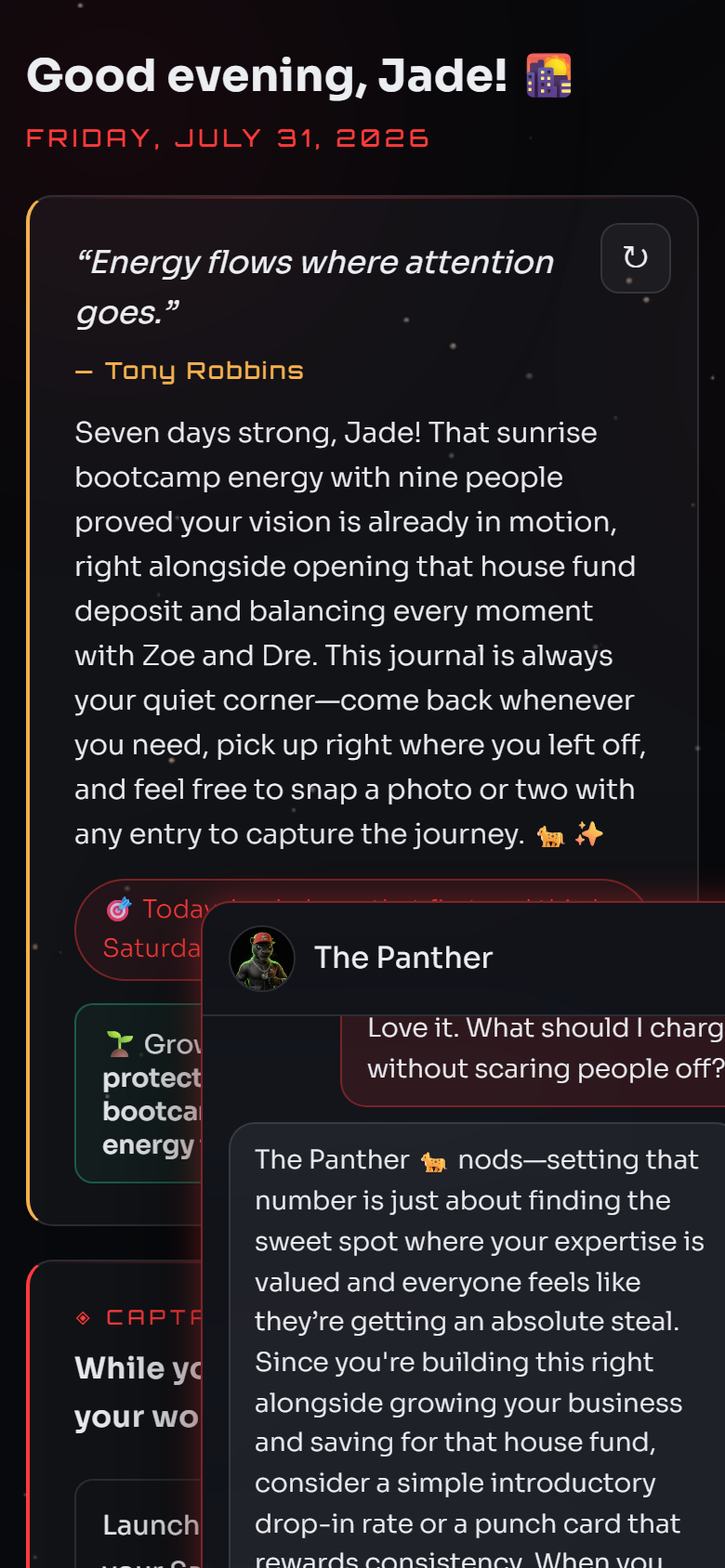
The journal's private AI coach conversation in FIVEPILLAR MINDSET. Use the workbook actions in this guide to carry an exercise into your own private entry.
The Core Pillars of a Grounded Service Journal
A resilient journaling practice balances community outreach with self-awareness. When service becomes an obligation or a distraction from personal inventory, it loses its grounding. Structuring your journal around clear reflection points helps maintain stability and purpose [S1].
Tangible Contribution
Record concrete actions where you helped someone else, whether offering a rideshare, listening during a meeting, or completing a quiet task without expecting credit.
Receiving Support
Acknowledge where you accepted help from peers, mentors, or loved ones, reinforcing the mutual nature of recovery and community connection [S1].
Healthy Boundaries
Track your limits to ensure service remains voluntary, preventing emotional burnout and protecting your personal stability and peace.
The Next Useful Action
End each reflection with one small, realistic step for tomorrow to keep your daily routine proactive, structured, and manageable.
Addressing Resentment and Knowing Your Limits
Service without boundaries often leads to resentment, which can threaten personal stability in recovery. When you overextend yourself out of guilt, people-pleasing, or fear, service becomes counterproductive. A recovery-aware journal offers a private, safe space to examine your motivations honestly [F1]. If helping someone leaves you feeling drained, angry, or resentful, make a note about this in your journal to identify where a boundary needs to be established. Writing down raw feelings helps separate healthy contribution from over-commitment. Systematically evaluating your daily energy and boundaries ensures that service remains an act of strength and connection, rather than an exhausting obligation [S1]. By recording both your contributions and your limitations, you build an accurate picture of your capacity, allowing you to show up consistently for yourself and others.
Try this in your journal
Use this simple, five-step reflection framework in your FIVEPILLAR journal to process service, gratitude, and daily boundaries with clarity [F1].
1. Capture Voice or Text Input
Open your private FIVEPILLAR journal and use voice input to speak freely about your day, naming one specific act of service or help you gave [F1].
2. Record Support Received
Note one instance where you accepted help, guidance, or encouragement from someone in your recovery network [S1].
3. Tag People and Places
Use library tools to save and tag searchable favorites like key people, meeting places, or uplifting activities for future reference [F5].
4. Identify Resentments and Limits
Write down any moment where you felt overextended or resentful, identifying the boundary needed to protect your well-being.
5. Set Next Action and Ask Your Coach
State your next useful action for tomorrow. Ask your coach: 'Based on my recent entries, am I maintaining healthy boundaries while staying connected?' [F1, F3].
Understanding Privacy and Personal Memory Bounding
Your recovery journal is a private, secure space designed to support honest self-reflection while respecting your personal data boundaries [F1].
600 Words
The coach memory relies on a bounded rolling summary capped at 600 words for lasting personal facts, keeping overall entry history private [F3].
100% Voluntarily Saved
Members choose what to write or save; public articles and external text are never automatically copied into personal journal entries [F2].
0 Exclusions Leaked
Generated drafts, research copy, scripts, and coach prose are explicitly excluded from personal memory condensation [F4].
Recovery isn't about performing perfection or pretending everything is fine. It is about waking up, taking honest inventory, helping where you can, and honoring your boundaries so you can show up again tomorrow.
A Mission of Honest Growth
Build a Lasting Record of Your Recovery Journey
Start a grounded journaling practice that honors your progress, tracks your habits, and keeps your memories safe [F1]. Experience voice journaling, recovery-aware coach chat, monthly reviews, and a printable yearbook with FIVEPILLAR [F1].
How does service journaling support recovery without causing burnout?
Grounded service journaling encourages you to reflect on both what you give and what you receive, while explicitly tracking your boundaries [S1]. By writing down feelings of resentment or fatigue, you learn when to say no and protect your health [S1].
Can expressive writing help improve personal well-being?
Research indicates that positive expressive writing interventions can support subjective health and well-being when focused on specific, authentic experiences rather than forced positivity [S2].
How does FIVEPILLAR protect my private entries?
FIVEPILLAR ensures members control what they write and save [F2]. Coach memory uses a bounded summary capped at 600 words for key context [F3], while generated drafts and research prose are excluded from memory condensation [F4].
Does journaling replace professional recovery support?
No. Journaling is an educational and reflective tool that complements community, peer support, and professional care, but it does not replace medical treatment or clinical therapy [S1].
FROM EDUCATION TO PERSONAL ACTION
Use this insight inside FIVEPILLAR MINDSET
This article remains public educational content. Inside the private journal, you decide whether to apply it to your own life, save a reflection or discuss it with your coach.
Recovery-aware journalUse private daily inventory, milestone reflection and optional program-aware support alongside real-world care.See how this feature works →
One Life Coach Operating SystemThe journal, memory, goals, timeline, map, favorites, coach and books are connected views—not separate journals.Explore the complete system →
Try it without an accountUse fictional sample data to feel the raw-words-to-coaching transformation. Nothing is saved and no paid AI call is made.Open the interactive demo →
Sources & verified facts
Product: A private AI journal with voice input, long-term condensed memory, coach chat, photos, places, habits, recovery-aware support, monthly reviews and a printable yearbook.
Private app behavior: Members choose what they write or save; public articles are not automatically copied into private journal entries.
Coach memory: The coach uses a bounded rolling summary capped at 600 words for lasting personal facts, while full private entries remain separate.
Memory exclusions: Generated drafts, blog copy, scripts, research text and the coach's prose are explicitly excluded from personal memory condensation.
Library tools: The journal supports searchable favorites for people, songs, dishes, recipes, places, books, activities, products and memories.
This article is for educational and self-reflection purposes only and does not constitute medical, clinical, or psychological advice. Journaling tools and recovery coaching support personal growth but are not substitutes for professional treatment.