How to Write a Personal Recovery Support Plan in a Journal
A structured, self-directed guide to mapping out your warning signs, coping tools, and key contacts—strengthening your daily discipline and keeping a permanent record of your progress.
A FIVEPILLAR MINDSET visual created for this guide. The practical journal exercise appears below.
🧭 The Recovery Path · Stage 1 of 6 — Starting or returning · See the whole path
The Foundation of a Written Recovery Plan
Taking control of your wellness requires a structured, clear approach to your daily environment and mental state. According to the Substance Abuse and Mental Health Services Administration (SAMHSA), recovery is a deeply personal, self-directed process of change through which individuals improve their health and wellness, live self-directed lives, and strive to reach their full potential [S1]. An essential part of taking this control is putting your plan in writing. When you commit your recovery plan to a journal, you transition from passive observation to active self-management [S2].
Writing down your strategies, triggers, and resources serves multiple purposes. First, it externalizes your thoughts, making complex emotions easier to manage when you are under stress. Second, it provides a highly objective, permanent record of what works and what does not. This process of documentation ensures that when challenge arises, you do not have to rely on memory or make high-stakes decisions under duress. However, it is vital to remember that a written recovery support plan journal is a supplemental tool for self-reflection and structure; it does not replace clinical treatment, licensed therapy, or active peer support groups [S1, S2].
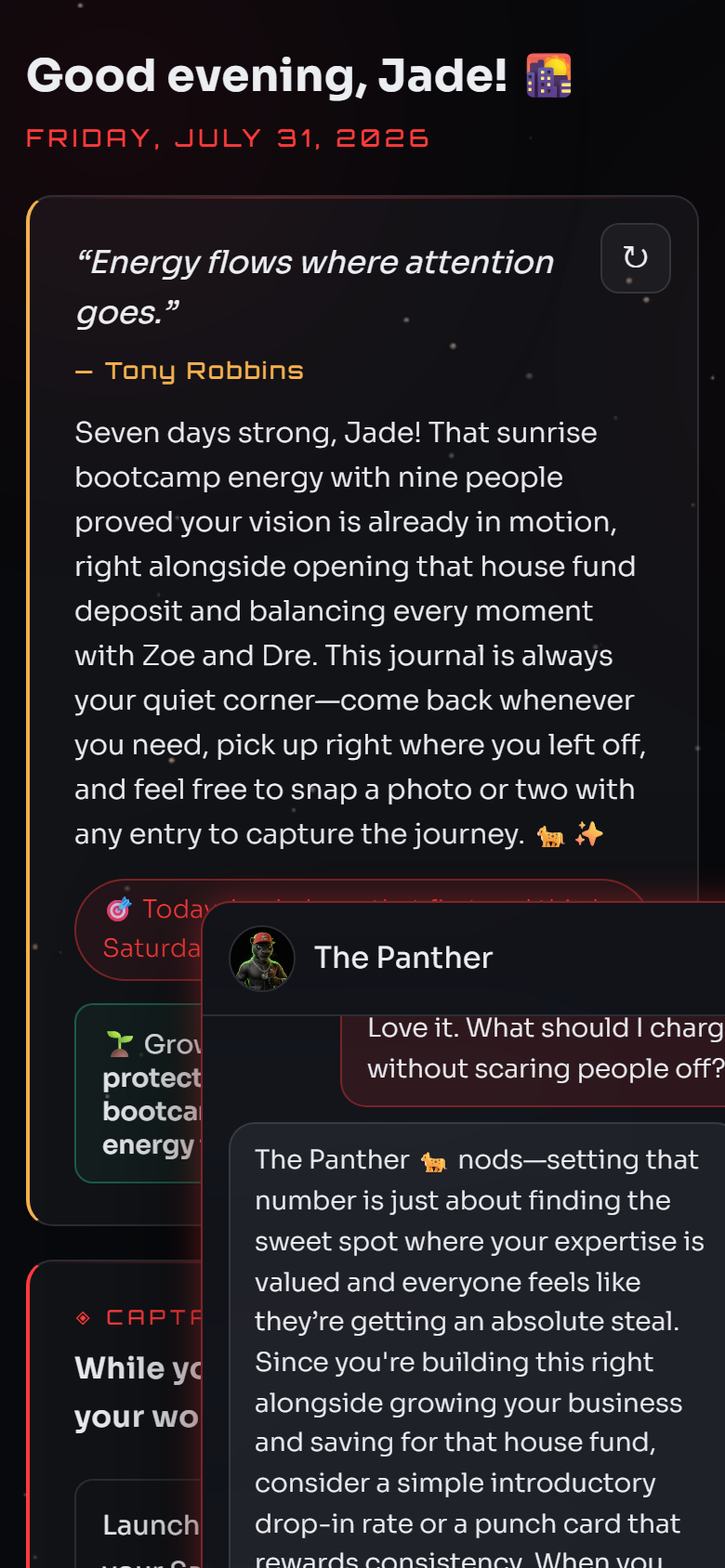
The journal's private AI coach conversation in FIVEPILLAR MINDSET. Use the workbook actions in this guide to carry an exercise into your own private entry.
The Seven Key Domains of a Journal-Based Recovery Plan
To build a truly functional recovery support plan journal, you must break it down into practical, actionable components. Focus on these seven specific domains to create a comprehensive personal framework in your daily writing.
1. Warning Signs and Triggers
Identify the subtle physical, behavioral, or emotional shifts that indicate your stress levels are rising or your routine is slipping. Write down specific warning signs—such as disrupted sleep patterns, isolation, missing scheduled habits, or persistent irritability. Recognizing these early warning signs allows you to intervene before a crisis occurs.
2. Trusted Contacts
Keep an explicit, readily accessible list of individuals you can call when you need immediate feedback or grounded support. This list should include peer sponsors, close family members, and trusted friends who understand your recovery journey and respect your boundaries.
3. Meetings and Services
Document the schedule, location, and contact information for your regular support groups, peer recovery meetings, or community services [S1]. Having these structured times permanently recorded in your routine helps reinforce your weekly commitment and discipline.
4. Safe Places and Environments
Define physical locations where you feel grounded, safe, and free from negative influences or triggers. This could include a specific park, a local community center, a trusted friend's home, or a quiet library. Knowing where to go in moments of high stress is crucial for emotional regulation.
5. Concrete Coping Actions
List immediate, non-destructive actions you can take when cravings, anxiety, or depressive thoughts emerge [S2]. These include breathing exercises, physical movement, cold exposure, writing out your thoughts, or calling a designated peer.
6. Practical Responsibilities
Recovery relies on restoring structure to your daily life. Detail your essential daily and weekly responsibilities—such as household chores, work tasks, basic financial management, and dietary needs. Maintaining these daily habits acts as a protective shield against stagnation.
Leveraging Digital Journaling Tools for Your Support Plan
A physical journal is a powerful starting point, but a private digital journal engineered for structured wellness tracking provides advanced tools that match the speed of your life [F1]. Here is how the FIVEPILLAR MINDSET platform helps you integrate and sustain your recovery support plan:
Voice-to-Text Input
When you are overwhelmed or exhausted, sitting down to type or write by hand can feel like an obstacle. Voice input allows you to speak your mind freely, capturing your immediate emotional state and reflection without friction [F1].
Searchable Favorites and Contact Libraries
Never search for a phone number or a safe location in a panic. The journal's library tools support searchable favorites for key people, safe places, and coping activities, giving you instant access when you need them most [F5].
Habit Tracking and Daily Reviews
Establish consistency by tracking your daily physical and mental discipline directly alongside your journal entries. Over time, monthly reviews help you spot patterns, celebrate milestones, and adjust your plan as your needs evolve [F1].
Recovery-Aware Coach Support
Engage with a private Coach Chat designed to provide grounded, compassionate support [F1]. The coach uses a bounded rolling summary capped at 600 words for lasting personal facts, ensuring the coach remembers your goals while your full private entries remain completely confidential [F3].
Try This in Your Journal: A 5-Step Setup Guide
Begin building your digital recovery support plan journal today by following this structured process. This exercise helps you map out your safety nets and daily habits clearly.
Step 1: Record Your Daily Baseline
Start by documenting what a balanced, healthy day looks like for you. Include your physical activity, sleep goals, and general emotional state when you are feeling solid. This forms your baseline metric.
Step 2: Save Your Core Safe Lists
Use the favorites library to log your top three safe places and your top three trusted contacts [F5]. Label them clearly so they are searchable in your private records.
Step 3: Define Your Daily Habits
Identify two daily habits that keep you grounded—such as 15 minutes of silent reflection or completing a specific physical chore. Set these up in your daily log [F1].
Step 4: Draft Your Crisis Response Action
Explicitly write out: 'If I experience warning sign X, I will immediately take coping action Y and call contact Z.' Keep this plan simple, direct, and free of ambiguity.
Step 5: Review Weekly and Monthly
At the end of each week, read back through your entries. Look for recurring warning signs or successful coping strategies, and let your monthly review synthesize your progress [F1].
Putting the Plan into Action: Daily Integration
A recovery support plan is only as good as its execution. It is easy to write a plan when things are going well, but the real test is how you engage with it during difficult moments. Make a habit of opening your journal during your morning routine to reinforce your commitment for the day [F1]. Check in with your baseline, confirm your daily responsibilities, and make sure your primary contacts are active.
*Make a note about this in your journal*: Today, document one warning sign you successfully navigated this week, no matter how small it felt.
If you find yourself struggling to articulate your thoughts, use the private Coach Chat to help organize your plans [F1].
*Ask your coach*: 'Can you help me outline a daily structure that keeps me accountable to my recovery habits when I feel overwhelmed?' This collaborative approach can provide the clarifying perspective you need to stay on track [F1, F3].
"Discipline is not about restriction; it is about building a structure so strong that no temporary storm can tear down your progress. Your journal is the permanent blueprint of that structure."
The Philosophy of the Five Pillars
Privacy, Boundaries, and Limitations
When documenting highly personal information, privacy is paramount. On the FIVEPILLAR MINDSET platform, members choose exactly what they write or save; public educational articles or drafts are never automatically copied into your private journal entries [F2]. To keep your reflection safe and focused, your private interactions with the Coach Chat are governed by strict memory constraints. The coach utilizes a bounded rolling summary capped at exactly 600 words for lasting personal facts, meaning the system remembers your ongoing goals while keeping your full private entries completely isolated [F3]. Furthermore, generated drafts, blog copy, scripts, and research text are explicitly excluded from this personal memory condensation, ensuring your reflective space remains uncluttered [F4].
While maintaining a highly disciplined journal is a powerful way to manage your habits and build self-awareness, it is not a cure, a clinical therapy program, or a replacement for professional intervention [S1, S2]. If you are experiencing a severe mental health crisis or substance-use challenge, please contact licensed medical professionals, certified counselors, or national crisis helplines immediately [S2].
Build Your Permanent Record of Progress
Take control of your growth, track your habits, and establish your personal recovery support plan in a completely private, recovery-aware digital journal. Start writing your story with FIVEPILLAR MINDSET today.
Can a journal plan replace regular therapy or support meetings?
No. A recovery support plan journal is an excellent tool for daily discipline, tracking, and self-reflection, but it does not replace professional therapy, clinical treatment, or the critical support found in peer recovery communities [S1, S2].
Who sees my private recovery support plan journal entries?
Only you. You have complete control over what you write or save. Your private journal entries remain entirely confidential, and public site copy or blog articles are never copied into your private files [F2].
How does the AI Coach remember my recovery plan goals?
The coach uses a bounded rolling summary capped at 600 words to remember essential, long-term personal facts you choose to share [F3]. This ensures the coach can support your ongoing journey while keeping your raw daily entries private and separated [F3].
Can I list professional crisis resources in my digital library?
Yes. The FIVEPILLAR MINDSET library tool allows you to save and search favorites for key contacts, places, and activities, making emergency resources easy to find in moments of stress [F5].
FROM EDUCATION TO PERSONAL ACTION
Use this insight inside FIVEPILLAR MINDSET
This article remains public educational content. Inside the private journal, you decide whether to apply it to your own life, save a reflection or discuss it with your coach.
Recovery-aware journalUse private daily inventory, milestone reflection and optional program-aware support alongside real-world care.See how this feature works →
One Life Coach Operating SystemThe journal, memory, goals, timeline, map, favorites, coach and books are connected views—not separate journals.Explore the complete system →
Try it without an accountUse fictional sample data to feel the raw-words-to-coaching transformation. Nothing is saved and no paid AI call is made.Open the interactive demo →
Sources & verified facts
Product: A private AI journal with voice input, long-term condensed memory, coach chat, photos, places, habits, recovery-aware support, monthly reviews and a printable yearbook.
Private app behavior: Members choose what they write or save; public articles are not automatically copied into private journal entries.
Coach memory: The coach uses a bounded rolling summary capped at 600 words for lasting personal facts, while full private entries remain separate.
Memory exclusions: Generated drafts, blog copy, scripts, research text and the coach's prose are explicitly excluded from personal memory condensation.
Library tools: The journal supports searchable favorites for people, songs, dishes, recipes, places, books, activities, products and memories.
The information provided in this article is for educational and self-reflection purposes only and does not constitute medical, psychological, or professional advice. Journaling and digital wellness planning support but do not replace professional medical or mental health diagnosis, treatment, or crisis intervention.