A FIVEPILLAR MINDSET visual created for this guide. The practical journal exercise appears below.
🧭 The Recovery Path · Stage 3 of 6 — Meetings, sponsor and community · See the whole path
Why Journaling Before and After Meetings Matters
Walking into an AA or NA meeting with an unexamined, racing mind often makes it difficult to listen attentively or articulate what you are going through [S1, S2]. Spending three to five minutes in a private journal before entering the room creates an intentional transition into the meeting space [S3]. Peer recovery programs like Alcoholics Anonymous and Narcotics Anonymous offer vital community support and shared experience [S1, S2], while a private journal provides a personal, confidential space where you can face raw truths without worrying about group dynamics [F1, F2]. Before the meeting begins, capturing your immediate mood, bodily tension, and daily stressors helps you recognize your current reality rather than acting out of unspoken anxiety [S3]. After the meeting, a brief debrief allows you to log crucial takeaways, store phone numbers of new contacts, and identify one specific action step for the day [F5]. Integrating this pre- and post-meeting journaling habit provides structured self-reflection alongside your fellowship routine [S1, S3].
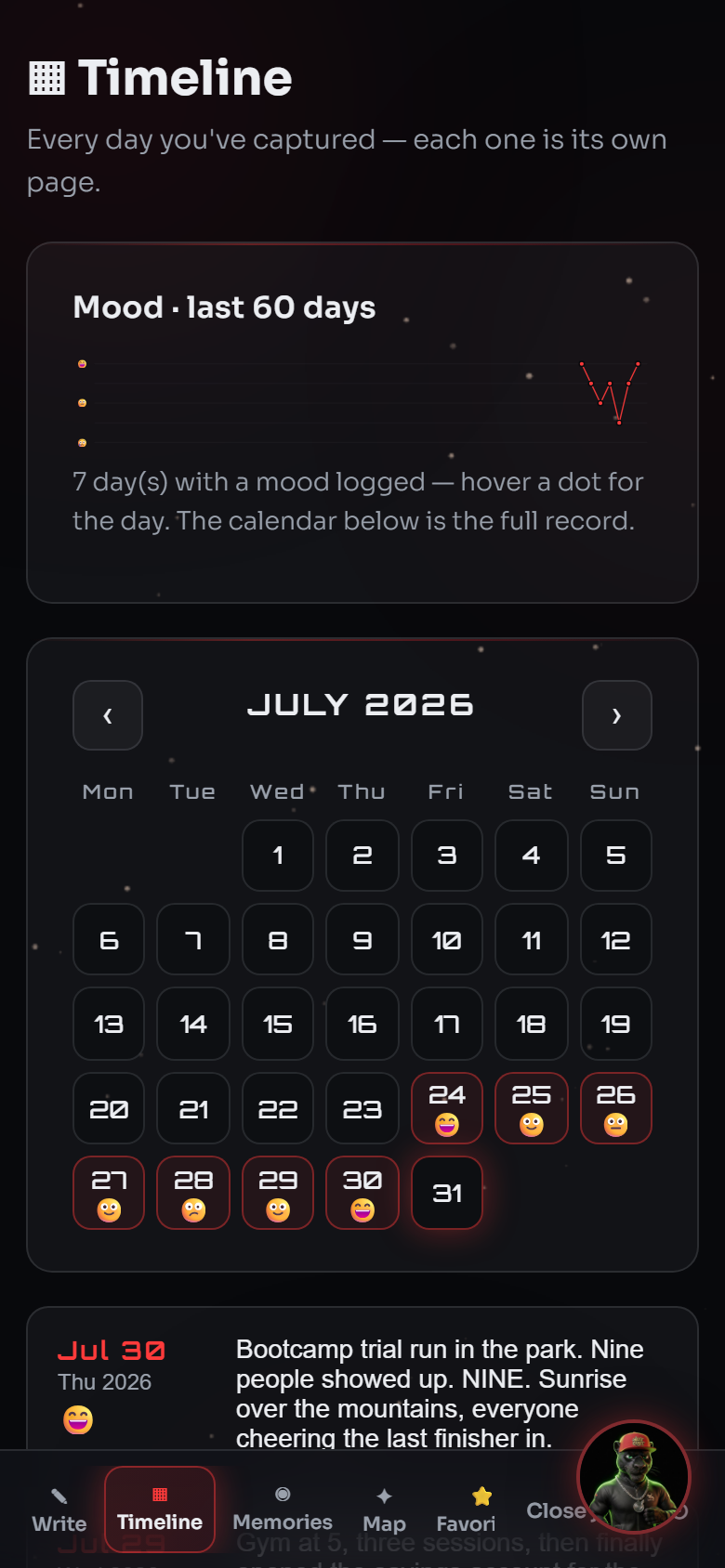
The searchable personal journal timeline in FIVEPILLAR MINDSET. Use the workbook actions in this guide to carry an exercise into your own private entry.
The 5-Minute Pre-Meeting Journaling Process
Taking five minutes before entering an AA or NA meeting grounds your thoughts and helps you arrive present and ready [S1, S2]. Use this straightforward sequence prior to your next meeting [F1].
1. Check Your Emotional Weather
Write down your immediate mood in two or three honest words. Naming anxiety, exhaustion, or gratitude strips away its hidden control before you sit down [S3].
2. Identify What Is Real Today
List recent triggers, wins, or craving spikes from the last 24 hours. Stick strictly to facts rather than exaggerated internal narratives [F1].
3. Outline What to Share or Ask
If you plan to raise your hand, note one clear challenge or question you need input on. If you plan to listen, write down what topic you hope to learn about [S1, S2].
4. Set Your Intention for the Room
Decide on your attitude before walking through the door—whether that means welcoming a newcomer, staying present during shares, or talking with a potential sponsor [S1, S3].
Try This in Your Journal
Use the features within FivePillar Mindset to build a structured, reliable routine before and after every recovery meeting [F1]. Members choose what they write or save, maintaining total control over their personal record [F2].
Voice Input for Car Reflections
Use voice input while sitting in your car before or after a meeting to speak your raw thoughts freely without typing [F1]. Your spoken reflections are stored securely in your private journal [F2].
Save Contacts in Searchable Favorites
When members share phone numbers or sponsor recommendations, save their details in searchable favorites for people and places so you can reach out when needed [F5].
Track Habits and Recovery Milestones
Log your meeting attendance alongside daily lifestyle habits to observe long-term patterns through monthly reviews and your printable yearbook [F1].
Make a Note About This in Your Journal
Action item: Open your private journal right now and create an entry titled 'Pre-Meeting Checklist' with three prompt questions: What am I feeling right now? What do I need help with today? What is my one post-meeting action step? [F1]
Post-Meeting Reflection: Capturing Names and Key Takeaways
The five minutes immediately following an AA or NA meeting are when key insights are freshest in your mind [S1, S2]. Leaving the parking lot without recording what you learned makes it easy to forget vital advice from speakers or sponsors [S1]. Taking two minutes in your car to debrief ensures that valuable recovery wisdom stays with you throughout the week [F1]. Write down specific quotes or ideas that resonated with you, notes from sponsor conversations, and names of group members you met [F5]. FivePillar Mindset provides searchable library tools so you can store contacts, places, books, and memorable quotes for easy access whenever you face cravings or doubt [F5]. Most importantly, end your post-meeting debrief by choosing one concrete action item—such as reaching out to a fellow member, reading recovery literature, or reviewing a step prompt—and execute it before your next meeting [S1, S3]. Ask your coach in the app: 'Based on my post-meeting notes, what recurring theme should I bring to my sponsor this week?' [F1, F3]
Five Pillars of Recovery-Aware Journaling
Structured reflection supports personal growth across every aspect of life when paired with strong boundaries and daily discipline [S3]. Here is how FivePillar Mindset safeguards and organizes your personal growth record [F1].
Private Ownership
Members decide what to write or save; public articles are never automatically copied into personal entries [F2].
Bounded Coach Memory
The coach utilizes a limited rolling summary capped at 600 words for personal facts, while raw entries remain separate [F3].
Memory Exclusions
Generated drafts, blog copy, research text, and coach prose are explicitly excluded from memory summaries [F4].
Permanent Life Record
Build a multi-year archive of your growth with voice entries, habit tracking, monthly reviews, and printable yearbooks [F1].
A private journal is where you face your raw truth before taking your seat in the room. It gives you the clarity to listen deeply and the courage to share what matters most.
Grounded Self-Honesty in Recovery
Start Your Private Recovery Journal Routine Today
Build emotional clarity before every meeting and retain the insights you gain afterward. Try FivePillar Mindset with voice input, recovery-aware habit tracking, searchable contacts, and printable annual yearbooks [F1, F5].
Does using a private journal replace going to AA or NA meetings?
No. A private journal is a personal tool for clarity and habit tracking; it does not replace the peer support, sponsorship, step work, or community found in AA or NA meetings [S1, S2, S3].
How can I log contact information from people I meet at meetings?
You can use the searchable library tools in FivePillar Mindset to save phone numbers, names, and meeting places under personal favorites so you can quickly retrieve them later [F5].
Is my journal data safe and kept private from public content?
Yes. Members control what they write or save, and public articles are never copied into private entries [F2]. Additionally, coach memory relies on a bounded 600-word summary, leaving full private entries separate [F3].
How does voice input help before or after a meeting?
Voice input allows you to speak your thoughts naturally while sitting in your car before or right after a meeting, capturing immediate reflections without needing to type [F1].
FROM EDUCATION TO PERSONAL ACTION
Use this insight inside FIVEPILLAR MINDSET
This article remains public educational content. Inside the private journal, you decide whether to apply it to your own life, save a reflection or discuss it with your coach.
Recovery-aware journalUse private daily inventory, milestone reflection and optional program-aware support alongside real-world care.See how this feature works →
One Life Coach Operating SystemThe journal, memory, goals, timeline, map, favorites, coach and books are connected views—not separate journals.Explore the complete system →
Try it without an accountUse fictional sample data to feel the raw-words-to-coaching transformation. Nothing is saved and no paid AI call is made.Open the interactive demo →
Sources & verified facts
Product: A private AI journal with voice input, long-term condensed memory, coach chat, photos, places, habits, recovery-aware support, monthly reviews and a printable yearbook.
Private app behavior: Members choose what they write or save; public articles are not automatically copied into private journal entries.
Coach memory: The coach uses a bounded rolling summary capped at 600 words for lasting personal facts, while full private entries remain separate.
Memory exclusions: Generated drafts, blog copy, scripts, research text and the coach's prose are explicitly excluded from personal memory condensation.
Library tools: The journal supports searchable favorites for people, songs, dishes, recipes, places, books, activities, products and memories.
FivePillar Mindset is a private personal journaling and wellness education application [F1]. It is not affiliated with, endorsed by, or connected to Alcoholics Anonymous (A.A.) World Services or Narcotics Anonymous (N.A.) World Services [S1, S2]. Journaling and coach features are not medical care, mental health therapy, or addiction treatment, and do not replace 12-step fellowship, sponsor guidance, or clinical treatment [S1, S3].