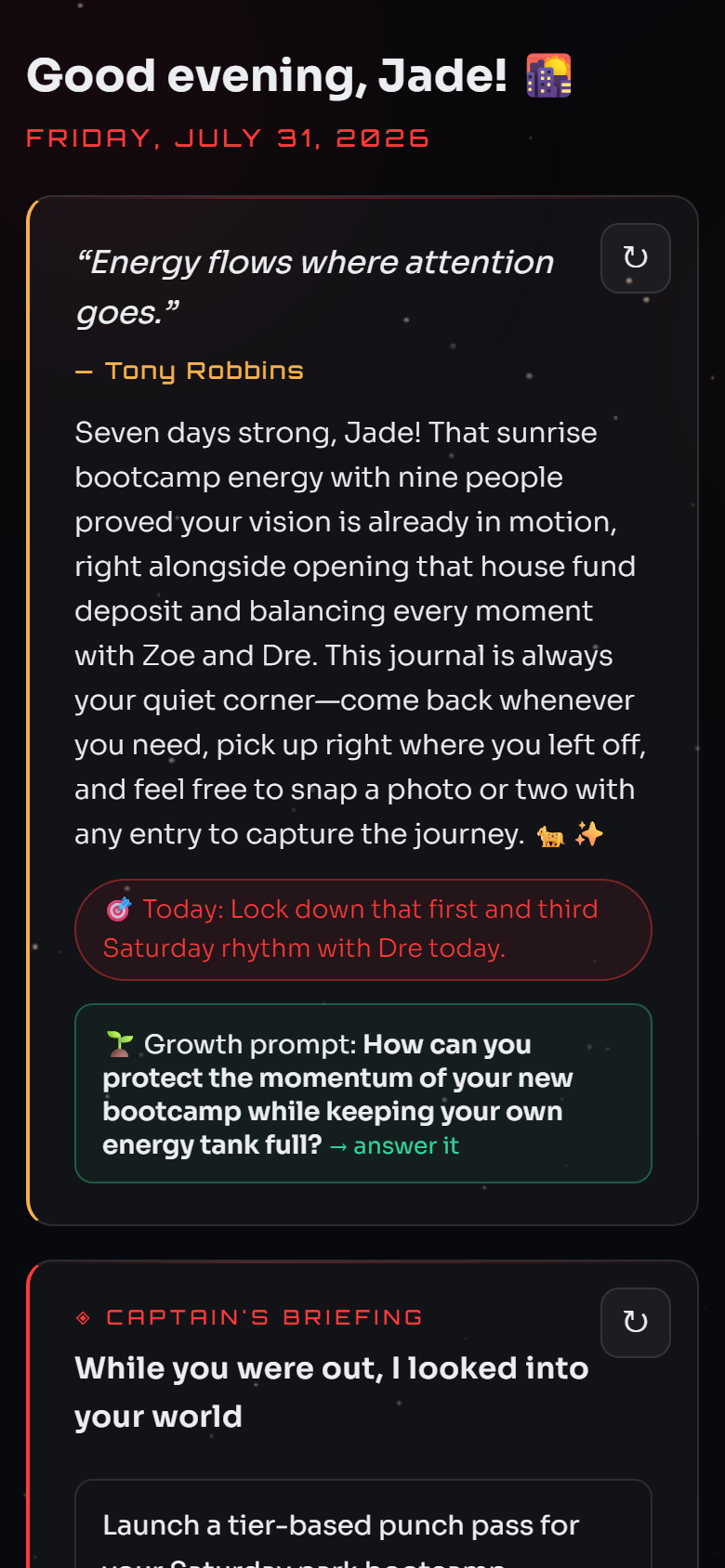
A FIVEPILLAR MINDSET visual created for this guide. The practical journal exercise appears below.
The Myth of the Silent Stoic: Why Emotional Accuracy is a Tactical Asset
For decades, men have been sold a false choice: either bottle up every ounce of pressure until you blow, or sit in a circle and adopt vague, academic therapy-speak that doesn't fit who you are. The truth is that mens emotional journaling strength is built on raw, precise accuracy. It is not about wallowing in feelings; it is about treating emotional responses as critical data points. When you experience anger, high pressure, or deep frustration, those are not signs of personal defect—they are diagnostic indicators that something in your environment, your habits, or your relationships requires immediate attention [S1].
If you run an engine hot without ever checking the dashboard indicators, the system eventually fails. Journaling acts as your personal diagnostic report. Instead of asking yourself 'how do I feel' in a vague, emotional sense, the five-pillar philosophy asks you to identify the source of the friction. By documenting exactly what is happening in your life, you build a permanent, unshakeable record that helps you spot patterns before they become destructive habits. This approach turns self-reflection into a structured, daily operational duty that reinforces your discipline and focus.
The private daily writing workspace in FIVEPILLAR MINDSET. Use the workbook actions in this guide to carry an exercise into your own private entry.
Translating the Heat: Dissecting Anger, Shame, and Responsibility
Anger and shame are powerful reactions that can either destroy your progress or serve as raw energy for course-correction. In the FIVEPILLAR MINDSET, we do not diagnose or label your character; we evaluate actions and outcomes. When you feel anger, it usually indicates a crossed boundary or an unmet expectation. When you feel shame, it often points to a gap between your current actions and your core values. Journaling allows you to step back from the raw heat of the moment and document the facts objectively.
Taking radical responsibility means acknowledging your role in every situation without making excuses or succumbing to self-pity. If you had a setback in your recovery or lost your temper at home, write down the timeline. Where were you? Who was there? What triggered the reaction? By writing these details down, you strip the situation of its emotional weight and reduce it to a set of facts you can manage. Systematic reviews show that externalizing these stressors through writing helps reduce the overall cognitive load and aids in long-term mental management [S1].
Navigating Grief and Recovery Without the Sugarcoating
Grief, loss, and the uphill battle of recovery are deeply heavy, and pretending they do not exist only slows down your progress. Whether you are dealing with the loss of a loved one, the end of a career path, or the daily battle of staying clean and disciplined, you need a private space to face those realities directly [S2]. You do not need artificial positivity; you need a place where you can say 'this hurts, and I am struggling today.'
Having a structured outlet to record your darkest days is a key tool in maintaining your sobriety and focus [S2]. The goal of a permanent life record is not to produce a sanitized highlight reel. It is to capture the complete picture of your journey, so that when you look back months or years from now, you can see exactly how you pulled yourself out of the mud. This builds an earned, authentic confidence that no external validation can match.
Try This in Your Journal: The FIVEPILLAR Workflow
This simple, daily workflow is designed to help you organize your thoughts, track your habits, and maintain absolute discipline without any forced emotional jargon. Use these steps inside your private journal to build a clear record of your daily life [F1].
1. Execute a Raw Voice Dump
Open your journal and use the voice input feature to speak freely for two minutes [F1]. Do not worry about structure, grammar, or sounding polite. Just speak the absolute, unvarnished truth about what is putting pressure on you right now.
2. Categorize the Context
Tag the specific places, habits, and people involved in your day [F5]. If a particular environment always spikes your anger or triggers a relapse temptation, noting these connections creates an undeniable, searchable data trail [F1, S2].
3. Make a Note About This in Your Journal
Explicitly write down one concrete action you will take to address the pressure today. Make a note about this in your journal: 'I cannot control the external stressor, but I can control my exact response to it at 14:00 today.'
4. Ask Your Coach to Stress-Test Your Logic
Use the integrated coach chat to review your perspective [F1]. Type this prompt: 'Ask your coach: Based on my entry today, am I taking full responsibility for this problem, or am I blaming external circumstances?' The coach uses a bounded rolling summary capped at 600 words for lasting personal facts [F3], while keeping your full private drafts entirely separate [F4].
Built for Privacy, Built for Legacy
A man's private thoughts must remain entirely secure. The FIVEPILLAR MINDSET journal is built from the ground up to ensure your entries are for your eyes only, while providing the technical tools to turn your daily inputs into a lifelong physical legacy [F1].
Voice Input & Rapid Capture
Speak your mind instantly when you are on the move. No typing required, allowing you to capture raw, authentic emotional data before you have time to overthink or sanitize it [F1].
600-Word Rolling Coach Memory
Your coach retains a high-level summary of your goals, history, and key facts up to 600 words [F3]. This ensures deep continuity during chats, while your full private journal entries remain completely isolated and private [F4].
Private Local Behavior
Members choose exactly what they write or save. Public educational articles are never automatically copied or pushed into your private journal space [F2].
Monthly Reviews & Printable Yearbook
At the end of each month, review your habits, places visited, and mental state [F1, F5]. Turn your year of hard work, discipline, and recovery into a high-quality physical book that stands as a permanent monument to your life [F1].
Recognizing the Limits of the Page
While mens emotional journaling strength is a powerful weapon for building discipline and processing stress [S1], it is vital to understand what it cannot do. A journal is a tool for self-reflection, habit tracking, and personal accountability; it is not a clinical treatment, a medical diagnostic tool, or a cure for mental health disorders. If you are experiencing severe depression, intense anxiety, substance withdrawal, or thoughts of self-harm, you must reach out to qualified professional support [S2].
There is no shame in seeking external reinforcements. Accessing resources like SAMHSA or professional counseling is a sign of operational discipline—getting the right tools for the job [S2]. Your private journal can act as an exceptional companion to professional care, helping you keep track of your daily state, but it remains a supplemental tool for self-mastery, not a replacement for human medical support.
This is not about feeling better; it's about getting better. You don't write to complain; you write to command your life. A permanent record of your discipline is the greatest asset you can leave behind.
The Code We Live By
Start Writing Your True Story Today
Stop letting your days blur together. Take control of your daily data, track your recovery, and build an authentic, permanent record of your journey with a private AI journal built for grounded men [F1].
How does the coach chat access my private thoughts?
To protect your absolute privacy, the coach chat does not scan your entire journal history. Instead, it utilizes a rolling summary capped at 600 words to remember vital personal facts you choose to share [F3], while your raw drafts, scripts, and daily logs are strictly excluded from this memory pool [F4].
Can I use voice input if I don't like typing?
Yes. The FIVEPILLAR journal features a seamless voice input tool designed for men who prefer to speak their thoughts directly and capture their raw state without worrying about typing out long entries [F1].
What features help me track my recovery and discipline over time?
The journal includes robust searchable library tools for people, places, habits, and memories [F1, F5]. This allows you to identify environmental triggers, track recovery consistency, and conduct comprehensive monthly reviews to see how your habits correlate with your overall state [F1, S2].
Does this journaling tool replace professional therapy or medical help?
Absolutely not. Journaling is a proven tool for self-management, reducing cognitive stress, and building mental discipline [S1], but it is not a diagnostic tool or a substitute for professional counseling, medical treatment, or crisis support [S2].
FROM EDUCATION TO PERSONAL ACTION
Use this insight inside FIVEPILLAR MINDSET
This article remains public educational content. Inside the private journal, you decide whether to apply it to your own life, save a reflection or discuss it with your coach.
AI journal and contextual coachCapture the reflection in your own words and ask a coach that can use bounded, editable personal context.See how this feature works →
One Life Coach Operating SystemThe journal, memory, goals, timeline, map, favorites, coach and books are connected views—not separate journals.Explore the complete system →
Try it without an accountUse fictional sample data to feel the raw-words-to-coaching transformation. Nothing is saved and no paid AI call is made.Open the interactive demo →
Sources & verified facts
Product: A private AI journal with voice input, long-term condensed memory, coach chat, photos, places, habits, recovery-aware support, monthly reviews and a printable yearbook.
Private app behavior: Members choose what they write or save; public articles are not automatically copied into private journal entries.
Coach memory: The coach uses a bounded rolling summary capped at 600 words for lasting personal facts, while full private entries remain separate.
Memory exclusions: Generated drafts, blog copy, scripts, research text and the coach's prose are explicitly excluded from personal memory condensation.
Library tools: The journal supports searchable favorites for people, songs, dishes, recipes, places, books, activities, products and memories.
The FIVEPILLAR MINDSET provides wellness education and personal journaling tools. Our services do not contain or constitute medical, psychological, or therapeutic advice, diagnosis, or treatment. If you are experiencing a mental health crisis or require addiction recovery treatment, please contact a professional health services provider or reach out to SAMHSA for immediate assistance.