A FIVEPILLAR MINDSET visual created for this guide. The practical journal exercise appears below.
The Blueprint: Eight Focal Points of the Five-Pillar Routine
Daily self-reflection requires more than simply staring at a blank page. The five-pillar philosophy, championed by Shaun 'Gotti' Williams, focuses on direct action, recovery-aware tracking, and honest self-assessment without hype. To translate this into a morning ritual, we use an eight-point structure that covers the physical, mental, social, and financial aspects of your day. This routine asks you to document your current condition, practice specific gratitude, declare your chief priority, anticipate a daily risk, note key people, schedule movement, manage money mindfully, and declare one promise to keep. By addressing these areas every morning, you cultivate a grounded, resilient mindset that prepares you for challenges before they arise. This structured approach helps ensure you do not wander aimlessly through your thoughts, but instead focus directly on what drives daily progress and lasting recovery.
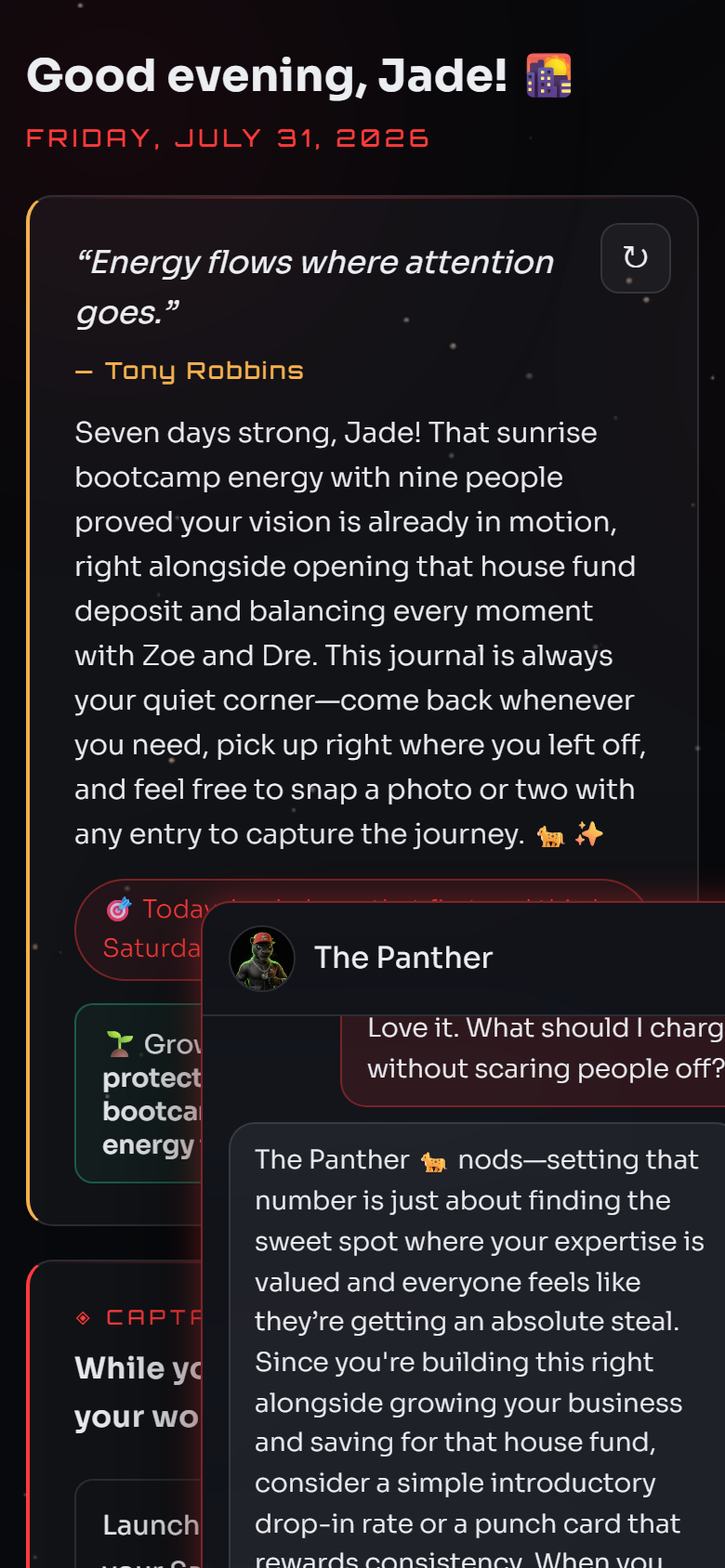
The journal's private AI coach conversation in FIVEPILLAR MINDSET. Use the workbook actions in this guide to carry an exercise into your own private entry.
Choose Your Track: The 3-Minute Express vs. 10-Minute Deep Dive
We recognize that time constraints vary. Some mornings demand swift, high-intensity focus, while others afford the space for profound introspection. You can execute this routine in two distinct formats inside the FIVEPILLAR MINDSET private app [F1].
The 3-Minute Express (Voice Input)
Open your FIVEPILLAR MINDSET app and activate the voice input feature [F1]. Spend exactly 20 to 30 seconds speaking freely about each of the eight focal points. Start with how your body feels (current condition), name one specific person you appreciate (gratitude), state your primary task (priority), identify the temptation or distraction to avoid (risk), name who you need to support or contact (people), state your physical plan (movement), note your financial boundary for the day (money), and declare the single commitment you will not break (promise). The voice-to-text engine captures your raw, unfiltered voice, allowing you to log your mindset even on your busiest mornings [F1].
The 10-Minute Deep Dive (Written Reflection)
For mornings when you require deeper clarity, sit down with a hot drink and write out your responses manually. Spend a full minute or two expanding on each category. Instead of just listing 'movement,' write down how you plan to manage your recovery balance. Use this time to explore the roots of your current condition or dissect a complex financial decision. This deep-dive format allows the system's long-term condensed memory to map patterns over time, providing deeper context for your weekly and monthly reviews [F1].
Try This in Your Journal: Your Daily Template
Ready to establish your morning routine? Follow these steps directly within the FIVEPILLAR MINDSET system to set up a permanent, structured record [F1].
Step 1: Record Your Daily Condition and Gratitude
Begin your entry by assessing your physical energy and mental clarity. Be honest. If you are exhausted, note it as a recovery metric. Follow this with a highly specific gratitude entry—avoid generic statements and instead focus on a concrete moment, book, or helpful conversation from the previous day.
Step 2: Log Your Priorities, Risks, and People
State your absolute priority for the day. Immediately identify the chief risk or distraction that threatens to derail you. Use the library tools to tag key people, places, or habits you are interacting with today to keep your logs searchable and organized [F5].
Step 3: Define Movement, Money, and Keep Your One Promise
Specify your movement plan and note your daily financial objective or boundary. Finish your entry by writing down exactly one promise you will keep to yourself today. This promise must be entirely within your control.
Understanding the Evidence: What Journaling Can and Cannot Do
We believe in a grounded approach to wellness. We do not make grand medical claims, nor do we promise that journaling solves clinical health conditions. A systematic review and meta-analysis published in the scientific literature investigated the efficacy of journaling in the management of mental illness, finding that while reflective writing is a valuable supportive tool for self-regulation, mindfulness, and tracking patterns, its direct impact on clinical outcomes varies and it should not replace professional medical or therapeutic care [S1]. Journaling is a practical framework for self-discipline, goal alignment, and cognitive organization. It provides a mirror for your daily actions and a structured outlet for stress, but it functions best as a companion to an active, disciplined lifestyle rather than a standalone cure [S1]. Make a note about this in your journal: 'I use my journal as a tool for self-discipline and daily alignment, acknowledging that growth requires consistent, active lifestyle choices.' Ask your coach: 'How can I use my journal prompts to better track my patterns of stress and recovery over the next month?' [F1]
Mindset Data Integrity: Privacy and Bounded Memory
Your journal is your private sanctuary. We built FIVEPILLAR MINDSET with clear boundaries to protect your personal history and maintain the integrity of your private space [F1].
Private App Control
Members maintain complete control over what they write or save. Public marketing articles, blog posts, or educational guides are never automatically copied or injected into your private journal entries [F2].
600-Word Coach Memory
The AI coach utilizes a bounded rolling summary capped strictly at 600 words to recall lasting personal facts and patterns, ensuring your coach chat remains relevant without storing or analyzing your entire unencrypted database of daily entries [F3].
Strict Memory Exclusions
To keep your personal memory clean, generated drafts, blog copy, scripts, external research text, and the coach's own prose are explicitly excluded from your personal memory condensation [F4].
Searchable Library Tools
Organize your life using dedicated, searchable library tools designed for your favorite people, songs, dishes, recipes, places, books, activities, products, and milestone memories [F5].
No hype, no magic promises, and no shortcuts. Building a permanent record of your life is about laying down one honest line at a time. It is the discipline of looking at your reality, marking your progress, and keeping the promises you make to yourself.
The Core Philosophy
Begin Your Five-Pillar Journey Today
Transform your chaotic mornings into a structured, disciplined launchpad. Start logging your current condition, gratitude, priorities, risks, people, movement, money, and promises in a private, secure environment [F1].
What are the five pillars of the morning journal routine?
The five pillars focus on daily tracking of your physical condition, mindset (gratitude and priorities), risks, connections (people), and physical/financial habits (movement and money), concluding with a single, kept promise to build unshakeable discipline.
How does the coach memory work without compromising my privacy?
The FIVEPILLAR MINDSET coach chat uses a bounded rolling summary capped at 600 words to remember your core goals and facts [F3]. Your full journal entries remain entirely private, and external drafts or research texts are completely excluded from this memory condensation [F4].
Can I use voice input for my morning routine?
Yes. The private app features a direct voice input tool [F1], allowing you to dictate your eight-point morning routine in under three minutes on busy mornings.
Is journaling a replacement for therapy or medical treatment?
No. While research indicates that journaling is an effective tool for self-reflection and tracking behavioral patterns, meta-analyses show that its efficacy as a clinical intervention is limited and it is not a substitute for professional mental health care [S1].
FROM EDUCATION TO PERSONAL ACTION
Use this insight inside FIVEPILLAR MINDSET
This article remains public educational content. Inside the private journal, you decide whether to apply it to your own life, save a reflection or discuss it with your coach.
Goals and next actionsTurn what this article brings up into a prioritized goal, a supplied deadline and a smaller next step.See how this feature works →
One Life Coach Operating SystemThe journal, memory, goals, timeline, map, favorites, coach and books are connected views—not separate journals.Explore the complete system →
Try it without an accountUse fictional sample data to feel the raw-words-to-coaching transformation. Nothing is saved and no paid AI call is made.Open the interactive demo →
Sources & verified facts
Product: A private AI journal with voice input, long-term condensed memory, coach chat, photos, places, habits, recovery-aware support, monthly reviews and a printable yearbook.
Private app behavior: Members choose what they write or save; public articles are not automatically copied into private journal entries.
Coach memory: The coach uses a bounded rolling summary capped at 600 words for lasting personal facts, while full private entries remain separate.
Memory exclusions: Generated drafts, blog copy, scripts, research text and the coach's prose are explicitly excluded from personal memory condensation.
Library tools: The journal supports searchable favorites for people, songs, dishes, recipes, places, books, activities, products and memories.
The FIVEPILLAR MINDSET journal is a personal development, habit-tracking, and lifestyle-logging application. It does not provide medical, clinical, or psychological therapy, and should not be used as a replacement for professional health care services.