How to Break Big Goals into Small Steps in Your Journal
A practical Five-Pillar guide to deconstructing major ambitions into priorities, milestones, quick wins, and encouraging progress reviews without shame.
A FIVEPILLAR MINDSET visual created for this guide. The practical journal exercise appears below.
The Five-Pillar Approach to Goal Deconstruction
Major life goals often fail not from a lack of ambition, but from an overwhelming absence of structure. When a target feels massive—whether restoring physical conditioning, rebuilding financial discipline, or committing to personal recovery—the brain experiences cognitive overload. The Five-Pillar Mindset framework solves this by establishing direct clarity across foundational life areas. Instead of fixating on a distant, intimidating end result, you deconstruct the vision into essential pillars, immediate priorities, and manageable time horizons. Research systematically examining journaling interventions demonstrates that structured reflective writing supports emotional clarity and self-regulation [S1]. However, reflection alone is insufficient without tactical execution. Deconstruction turns emotional intent into daily action steps. By naming what actually matters today, you strip away fluff and isolate the single next physical action required. Within FivePillar Mindset, goal setting is treated as a skill of honest self-assessment, encouraging steady momentum without perfectionism or shame [F1].
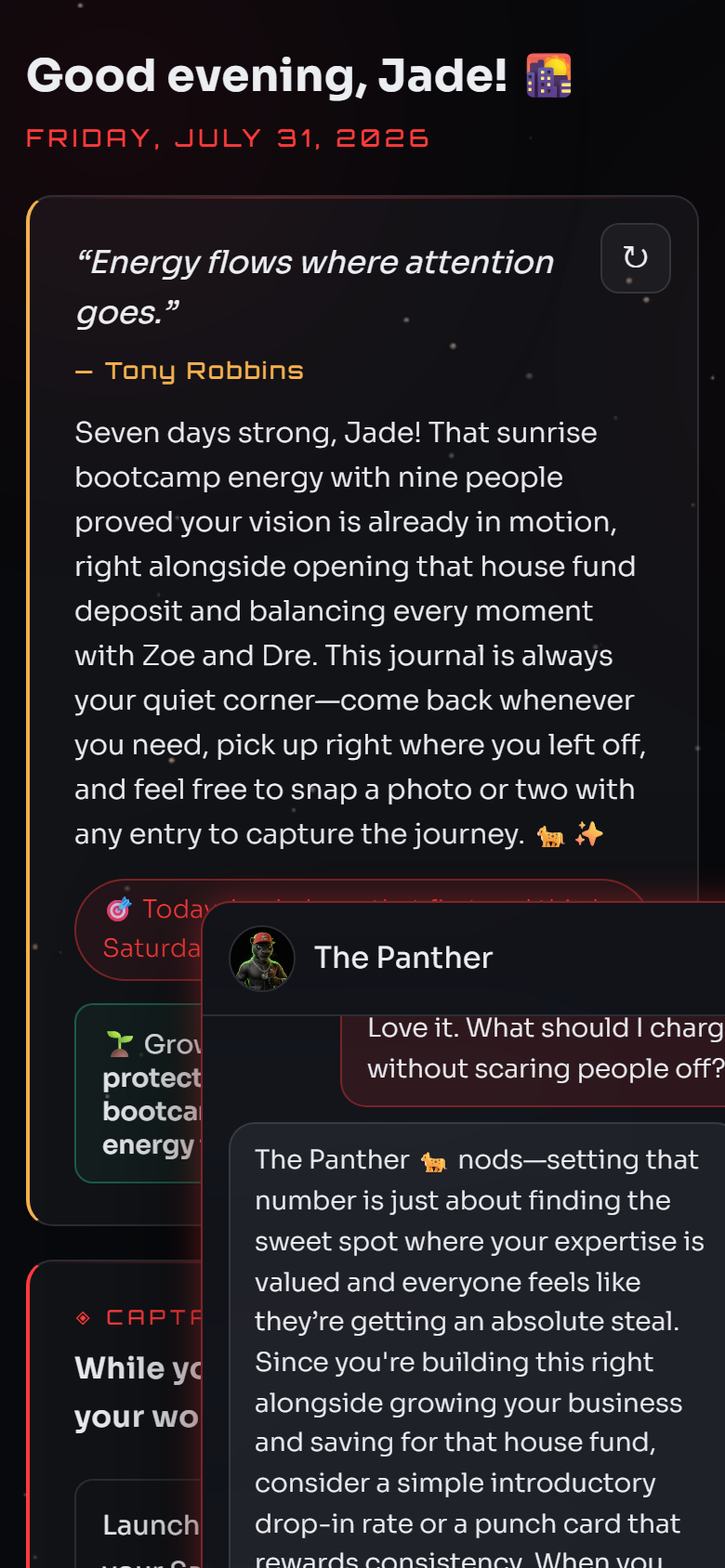
The journal's private AI coach conversation in FIVEPILLAR MINDSET. Use the workbook actions in this guide to carry an exercise into your own private entry.
The Deconstruction Process: From Vision to 5-Minute Wins
Converting an abstract ambition into measurable momentum requires a step-by-step pipeline. By moving systematically from macro priorities down to micro actions, you eliminate decision friction.
1. Define Primary Priorities
Select one to three non-negotiable focal points. Grouping ambitions within clear pillars prevents daily effort from scattering across too many competing desires.
2. Establish Key Milestones
Divide your six-month or annual vision into clear quarterly markers. Milestones serve as directional signposts rather than rigid strictures, signaling whether your current pace is realistic.
3. Isolate 5-to-30 Minute Quick Wins
Break each milestone down into tiny, low-friction micro-actions. Completing a five-minute habit builds momentum faster than waiting for an uninterrupted two-hour block.
4. Schedule Deadlines & Encouraging Reviews
Assign practical target dates to milestones, and pair them with weekly or monthly journaling reviews. Evaluating progress with compassion ensures missteps become data rather than sources of guilt [F1].
How Your AI Journal Tools Keep Progress Shame-Free
FivePillar Mindset equips you with specific built-in tools engineered to organize your goals, record personal breakthroughs, and celebrate real effort without arbitrary pressures [F1].
Goals Screen & Gold-Star Steps
Track major targets alongside sequential micro-steps. Marking completed steps with gold-star milestones creates a clear visual timeline of real work accomplished over time [F1].
Voice Input for Rapid Reflection
Capture sudden breakthroughs, daily roadblocks, or task updates instantly hands-free using voice input, removing writing friction when energy is low [F1].
Recovery-Aware Coach Chat
Engage with an AI coach that offers grounded, non-judgmental guidance tailored to your active habits, recovery context, and growth trajectory [F1].
Long-Term Condensed Memory
The coach retains key personal context through a bounded rolling summary capped at 600 words, ensuring long-term continuity while personal entries remain separate [F3].
Try this in your journal
Follow this exact five-step workflow inside FivePillar Mindset to turn a complex goal into immediate, achievable micro-actions today.
1. Log Your Major Vision via Voice
Open your journal and use voice input to speak freely about your big objective for two minutes without overthinking [F1].
2. Extract Three Micro-Steps onto the Goals Screen
Identify three 5-to-30 minute quick wins from your entry and add them directly into your Goals screen with concrete deadlines [F1].
3. Tag Key Favorites in Your Library
Save supporting resources, places, books, or inspiring mentors into your searchable library tools to keep reference materials handy [F5].
4. Check Off Gold-Star Milestones
As you complete each small action, tap to check off the step, earning gold-star visual feedback that reinforces positive habit loops [F1].
5. Prompt Your Coach for Honest Feedback
Ask your coach to review your current weekly breakdown, offering direct, motivating insight without pretense or harsh judgment [F1].
Discipline is not about flawless execution every single day; it is about having a grounded structure that welcomes you back the moment you lose your footing.
Grounded Discipline, Not Hype
Nuance, Boundaries, and Realistic Expectations
While structured goal breakdown and reflective journaling provide valuable psychological tools for self-growth and habit retention, it is vital to recognize their boundary conditions. Academic meta-analyses indicate that while journaling yields measurable benefits for emotional regulation and psychological well-being, it operates as an educational and self-development practice rather than a substitute for clinical healthcare or professional therapy [S1]. In FivePillar Mindset, privacy and personal control remain paramount. Reading a public article or guide on this marketing site does not automatically sync text into your private journal space; members select what they write or record [F2]. Furthermore, the system safeguards your personal agency through explicit boundaries: generated drafts, blog copy, scripts, and coach prose are explicitly excluded from personal memory condensation [F4]. The AI coach relies strictly on a bounded rolling summary capped at 600 words for personal facts, while full private entries remain completely separate [F3].
Make a note about this in your journal: Record how it feels to complete a 5-minute task versus postponing a massive goal.
Ask your coach: 'Based on my recent entries, what is one 15-minute quick win I can complete today to move closer to my primary milestone?'
Turn Your Major Goals Into Daily Action
Stop letting massive ambitions create anxiety and freeze your progress. Deconstruct your vision, build sustainable habits, and preserve a permanent record of your personal growth with FivePillar Mindset [F1].
How do I break a big goal into small steps using a journal?
Start by defining your primary priority, dividing it into sequential quarterly milestones, and then listing 5-to-30 minute quick wins. Track these steps on your Goals screen and check them off as you complete them [F1].
How does the AI coach keep track of my goals without violating privacy?
The coach uses a bounded rolling summary capped at 600 words to remember essential personal context, while your full private journal entries remain separate and unexposed [F3].
Are public articles or guides automatically saved to my journal?
No. Members maintain total control over what they write or save; reading public educational pages on our site never automatically creates entries in your private journal [F2].
Can journaling replace professional therapy or clinical care for mental health?
No. While systematic research shows reflective journaling aids self-regulation and goal setting [S1], FivePillar Mindset is an educational self-improvement tool, not a clinical therapy service.
FROM EDUCATION TO PERSONAL ACTION
Use this insight inside FIVEPILLAR MINDSET
This article remains public educational content. Inside the private journal, you decide whether to apply it to your own life, save a reflection or discuss it with your coach.
Goals and next actionsTurn what this article brings up into a prioritized goal, a supplied deadline and a smaller next step.See how this feature works →
One Life Coach Operating SystemThe journal, memory, goals, timeline, map, favorites, coach and books are connected views—not separate journals.Explore the complete system →
Try it without an accountUse fictional sample data to feel the raw-words-to-coaching transformation. Nothing is saved and no paid AI call is made.Open the interactive demo →
Sources & verified facts
Product: A private AI journal with voice input, long-term condensed memory, coach chat, photos, places, habits, recovery-aware support, monthly reviews and a printable yearbook.
Private app behavior: Members choose what they write or save; public articles are not automatically copied into private journal entries.
Coach memory: The coach uses a bounded rolling summary capped at 600 words for lasting personal facts, while full private entries remain separate.
Memory exclusions: Generated drafts, blog copy, scripts, research text and the coach's prose are explicitly excluded from personal memory condensation.
Library tools: The journal supports searchable favorites for people, songs, dishes, recipes, places, books, activities, products and memories.